

Artificial Intelligence (AI) maps plant compounds that may aid sleep
July 06, 2026Food scientists at the National University of Singapore (NUS) have used machine learning to sift through over 2,300 scent molecules from aromatic plants and identify compounds with sleep-promoting potential, an approach that could accelerate the discovery of natural sleep aids.
Sleep is essential for health, learning and daily wellbeing, but sleep problems affect up to one-third of people worldwide. While sleeping pills can help some patients, they may also cause side effects and are not suitable for everyone, motivating the search for alternative approaches. Aromatic plants, from lavender to basil, have long been used to promote relaxation, but until now, it has remained difficult to determine which scent molecules genuinely influence sleep.
A data-driven approach to an age-old remedy
A research team led by Assistant Professor ZHANG Dachuan from the Department of Food Science and Technology at NUS developed a data-driven approach to search for these molecules, combining AI with large-scale data on plant chemistry. In a study featured on the cover of the journal Digital Discovery, the team built a curated library of 2,391 scent molecules found in 991 aromatic plants, before training a machine-learning model to recognise patterns linked to sleep-promoting activity. This research work is a collaboration with Professor KOU Xingran from the Shanghai Institute of Technology, China.
The model performed strongly, achieving 96.1% accuracy during testing, meaning it could correctly distinguish sleep-promoting compounds from inactive ones in the majority of cases. It also highlighted hundreds of plant scent molecules as high-potential candidates. To examine whether the computer predictions could translate into biological effects, the team selected five commercially available molecules for experiments. Four of them, carvacrol, safranal, vanillin and methyl eugenol reduced wakefulness and increased a restorative sleep stage known as non-rapid eye movement sleep. The study also found that these molecules influenced GABA receptors, part of the brain’s main calming signalling system and a well-known target of conventional sleep medications. This provides early clues about the ways in which certain plant aromas may affect sleep-related pathways.
| Phylogenetic tree of aromatic plants from the study, with green bars indicating which plant families are richest in scent molecules predicted to promote sleep. Families such as Asteraceae, Lamiaceae and Lauraceae show the highest concentration of promising compounds. [Credit: Digital Discovery/Royal Society of Chemistry] | 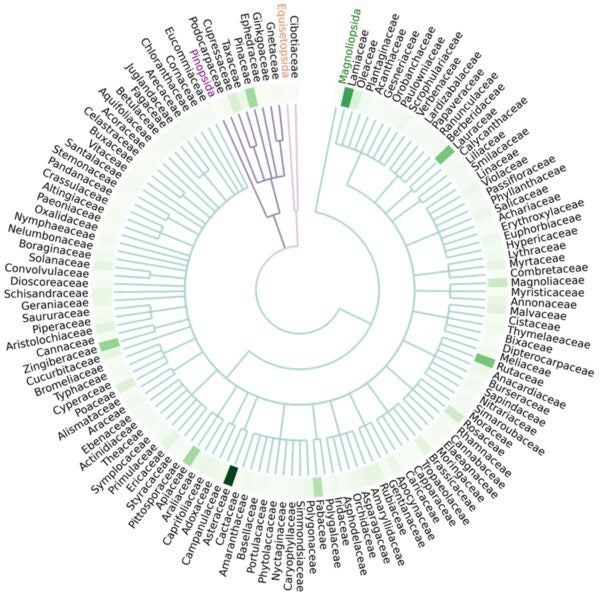 |
Prioritising aromatic plants with high sleep-promoting potential
Beyond individual molecules, the team also ranked plant families and species that are particularly rich in promising scent molecules. Across the 991 aromatic plants analysed, plant families such as Asteraceae, Lamiaceae and Lauraceae stood out, with species including lavender and perilla highlighted for further investigation.
The findings do not represent a ready-made sleep product. Instead, they provide a “practical map” for identifying promising directions for future research. The approach demonstrates the potential of AI to accelerate the discovery of natural ingredients for health products, functional foods, fragrances and wellbeing applications.
Assistant Professor Zhang said, “Many people associate calming plant aromas with better sleep, but stronger evidence is needed to understand which molecules are responsible and the mechanisms behind their effects. Our aim is to transform traditional knowledge and scattered chemical data into a practical map that can guide the development of safer and more targeted sleep-related products in the future.”
Future work will examine long-term safety, the interaction between mixtures of scent molecules, and the extent to which the same effects can be observed in broader biological and human studies.
Reference
Shi P; Huang X; Ke Q; Kou X*; Zhang D*, “Mapping sleep-promoting volatiles in aromatic plants with machine learning: a comprehensive survey of 2300 molecules” Digital Discovery Volume: 5 Pages: 1068–1078 DOI: 10.1039/D5DD00173K Published: 2026.