
New tool map complex energy bands into graphs for Artificial Intelligence (AI)-driven discovery
June 24, 2026Researchers from the National University of Singapore (NUS) have developed a new artificial intelligence (AI) benchmark and an open-source software that transform the complex energy bands of crystals into mathematical graphs (networks) that AI can efficiently learn from, opening new possibilities for the data-driven design of materials and metamaterials.
A hidden world of patterns
Every material is governed by its set of allowed energies, also known as its energy bands or spectra that determines its electrical conductivity, light absorption and response to its surroundings. In particular, open physical systems possess complex bands that assume the shape of interesting arcs, loops or even complicated hieroglyphic-like patterns. Understanding the link between these patterns and measurable experimental signatures remains one of the key open questions in condensed matter physics.
Previously, extracting these patterns relied entirely on manual plotting, visual inspection and tabulation, preventing systematic large-scale studies. This work, published at the International Conference on Learning Representations (ICLR) 2026, overcomes that bottleneck with a framework that makes large-scale extraction both automated and efficient.
The multidisciplinary research team was led by Associate Professor Ching Hua LEE from the NUS Department of Physics, in collaboration with Associate Professor Duane LOH from the NUS Departments of Physics and Biological Sciences, and Assistant Professor Kenji KAWAGUCHI from the NUS Department of Computer Science.
From manual inspection to automated extraction
The team developed Poly2Graph, a high-performance software pipeline that takes a standard mathematical description of a crystal, its Hamiltonian, and automatically outputs the corresponding “Hamiltonian spectral graph” (HSG). This automation transforms a previously slow, error-prone task into one that can be carried out at scale.
Using Poly2Graph, the team generated HSG-12M, a dataset containing 11.6 million static graphs and 5.1 million evolving graphs across 1,401 categories, distilled from raw spectral data. HSG-12M is a large-scale dataset of spatial multigraphs. This is a type of graph that preserves the number, shape and geometry of every connection between two points, rather than collapsing multiple routes into a single abstract link. The difference resembles knowing that two cities are connected by road, versus looking at a map that shows every road between them, including its path, shape, and position in space.
This richer information is essential not only for energy spectra, but also for many real-world networks, such as transportation systems, brain connectivity maps and protein structures. Before this work, no large-scale resource existed for testing and developing AI models that can effectively learn such networks.
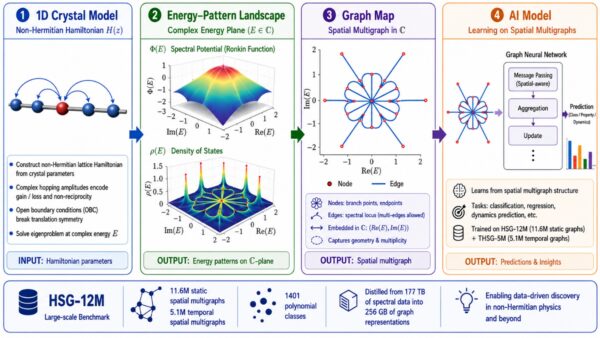
Poly2Graph converts complex-energy spectra into mathematical graphs that AI can efficiently read, enabling HSG-12M, a large benchmark for graph-based AI. [Image generated using AI tool based on the author’s publication]
New challenges for graph AI
Benchmarks with widely used graph AI models show that the geometric patterns contained in HSG-12M remain far from fully understood. Existing models can already narrow candidates down to a small shortlist of plausible material families. However, fully capturing the details of multiple curved connections between points (edge multiplicity and geometry) together remains an open challenge, one that opens the door to a new direction in AI research known as geometry-aware graph learning.
Associate Professor Lee said, “By encoding complex energy spectra as mathematical graphs, we provide a representation of energy bands that fully exploits advances in graph AI.”
The first author of the publication, Mr Xianquan YAN added, “This can inspire the prediction and design of new metamaterial platforms with novel sensing properties.”
Moving forward, the team plans to expand Poly2Graph and HSG-12M as open resources for researchers in physics, mathematics and machine learning. These tools could support the design of materials and metamaterials with targeted electronic, optical or acoustic behaviour, and inspire the development of AI methods for scientific data that cannot be fully understood using existing graph neural networks.
Reference
Yan X*; Akgün H; Kawaguchi K; Loh ND*; Lee CH*, “HSG-12M: A Large-Scale Benchmark of Spatial Multigraphs from the Energy Spectra of Non-Hermitian Crystals”, The Fourteenth International Conference on Learning Representations (ICLR 2026) OpenReview: https://openreview.net/forum?id=YxuKCME576. Published: 2026.