

A smarter catalyst to turn carbon dioxide and waste into fertiliser
June 04, 2026Researchers from the National University of Singapore (NUS) have developed a computation-guided strategy to produce urea more efficiently from carbon dioxide and nitrate. By combining large language models, density functional theory calculations and experiments, the approach identified a cadmium-modified iron oxide catalyst that maintains high urea selectivity at practical current densities.
A cleaner path to fertiliser
Urea is one of the world’s most widely used fertilisers, but its conventional production comes at a heavy environmental cost. The industrial process accounts for more than two per cent of global energy consumption and releases over 200 million tonnes of carbon dioxide each year. A cleaner alternative is to produce urea electrochemically, using low-carbon electricity to convert carbon dioxide and nitrate into a useful product. However, this approach has been difficult to scale up. At the high current densities needed for practical production, the catalysts often favour competing side reactions, such as hydrogen gas formation or carbon dioxide reduction to other products. These side reactions reduce urea production efficiency and make scale up challenging.
The research team led by Assistant Professor Pengfei OU from the NUS Department of Chemistry and Assistant Professor Lei WANG from the NUS Department of Chemical and Biomolecular Engineering developed a new catalyst design strategy for high-rate electrochemical urea synthesis.
The research breakthrough was published in the journal Nature Synthesis.
From data mining to catalyst design
A key feature of the work is the team’s use of AI to guide catalyst development. The researchers first used a large language model to survey reported urea electrosynthesis studies and identify a major bottleneck in the field: many catalysts show good selectivity at low production rates but fail to maintain high urea output at industrially relevant current densities. Techno-economic analysis showed that a urea partial current density of approximately 100 mA cm−2 is the minimum threshold for cost-competitive industrial production.
Armed with this insight, the researchers used theoretical calculations to screen for catalyst materials that suppress unwanted side reactions while promoting the activation of nitrate, which is a key step in urea formation. This led them to iron oxide as a promising base material, and subsequently to the incorporation of cadmium to address a remaining challenge, which is hydrogen evolution driven by carbon monoxide species adsorbed on the iron surface.
The resulting cadmium-modified iron oxide catalyst, known as Cd–Fe2O3, achieved a urea partial current density of about 140 mA cm−2, above the industrially relevant threshold, while converting more than half of the electrical charge into urea. This is a significant improvement over most existing systems, which struggle to maintain such selectivity at high production speeds. The catalyst also demonstrated stable performance over 100 hours of continuous operation, an important step towards practical deployment.
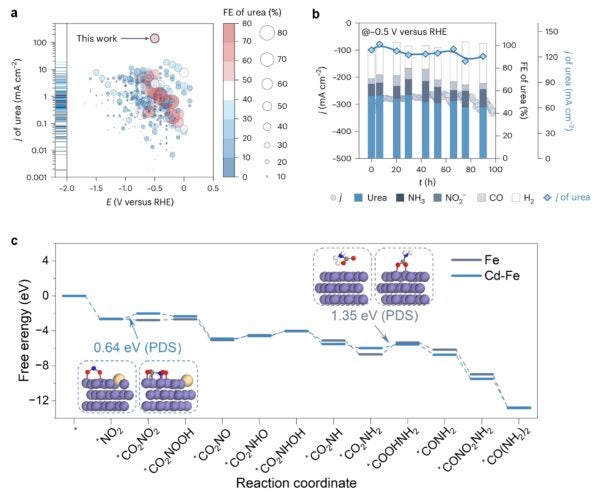
(a) Performance comparison of reported urea electrosynthesis catalysts, showing that the Cd–Fe2O3 catalyst developed in this work (highlighted) achieves both high urea selectivity and high production rate. (b) The Cd–Fe2O3 catalyst maintains stable urea production over 100 hours of continuous operation at −0.5 V versus RHE (a standard electrochemical reference potential). (c) Density functional theory (DFT) calculations show that cadmium (Cd) modification makes the urea-forming pathway easier by lowering the key energy barrier, helping the catalyst favour urea production over side reactions. [Image credit: Nature Synthesis]
Density functional theory calculations provided atomic-level insight into why the catalyst works. Adding cadmium alters the electronic structure of iron sites, making it harder for unwanted species, carbon monoxide and hydrogen, to stick to the catalyst surface. This suppresses the undesired hydrogen gas formation and frees up the catalyst to promote carbon–nitrogen bond formation that is the key step towards urea production.
Assistant Professor Ou said, “Our study shows that artificial intelligence and quantum-level simulations can do more than explain experimental results. They can help identify the right design principles from the beginning. This approach provides a powerful route for developing catalysts for sustainable fertiliser and chemical production.”
Towards sustainable chemical manufacturing
The work demonstrates that artificial intelligence, theoretical simulations and laboratory experiments can be integrated to accelerate catalyst discovery. Looking ahead, the team aims to improve catalyst durability, safety and scalability further, while extending this computation-guided design strategy to other sustainable chemical transformations.
Reference
Hu B; Liu Y; Zhou Y; Yang S; Wang Z; Tew YS; Shankar H; Wang X; Ou P*; Wang L*, “Electrosynthesis of urea on cadmium-modified iron oxide” Nature Synthesis DOI: 10.1038/s44160-026-00995-9 Published: 2026.