Artificial Intelligence (AI) speeds up drug discovery for diabetic wounds
May 25, 2026Researchers from the National University of Singapore (NUS) have developed an AI-guided workflow that combines artificial intelligence (AI) with molecular simulations to identify potential drug candidates for diabetic wound healing, identifying folic acid, a common vitamin, as a top candidate.
A complex healing challenge
Diabetic wounds, particularly diabetic foot ulcers, are often difficult to heal because many biological processes are disrupted at the same time. Inflammation, tissue repair and cell growth can all be affected, making it challenging to identify which existing drugs could help support wound recovery.
The multidisciplinary research team was led by Professor Giorgia PASTORIN from the NUS Department of Pharmacy and Pharmaceutical Sciences in collaboration with Associate Professor Chen-Hua YEOW from the Department of Biomedical Engineering and Associate Professor Min-Yen KAN from the Department of Computer Science. Their approach brought together AI-based literature analysis, molecular-level computational simulation and laboratory experiments, screening nearly 3,000 existing drugs and reducing the time from literature review to lab testing by more than 70%.
The research breakthrough was published in the journal ACS Nano Medicine.
From thousands of candidates to a single promising lead
Instead of examining one drug or one protein at a time, the team mapped 2,989 existing drugs against 8,739 proteins linked to diabetic wound healing. AI was used to scan scientific literature to identify the ways different drugs may influence these proteins. Computational chemistry was then used to study the interactions between the most promising drug molecules and these proteins at the molecular level. Together, these steps narrowed the search from millions of possible combinations to 35 candidate drugs and 50 key proteins for detailed analysis.
One of the top-ranked candidates was folic acid, a vitamin widely known as a dietary supplement but not commonly used for diabetic foot ulcer treatment. When the team tested folic acid in laboratory wound-healing experiments using skin cells, it significantly improved wound closure compared with untreated cells, supporting the prediction from the AI and modelling workflow.
Overall, the integrated approach shortened the journey from literature review to laboratory testing by more than 70% compared with conventional approaches, highlighting the potential of computational models for drug repurposing and novel therapeutic strategies that improve healing outcomes and reduce complications in diabetic foot ulcer management.
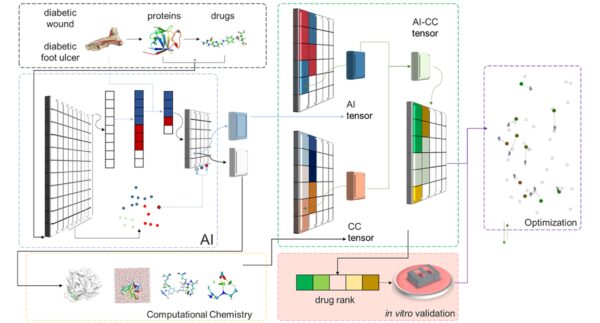
From data to discovery: Starting from disease and drug data (top left), AI scans the scientific literature to identify which drugs may affect wound-related proteins (centre left). Computational chemistry then measures the strength of those drug–protein interactions (bottom left). The two sets of results are combined into a single ranking (top centre), and the top candidates are tested in laboratory wound-healing experiments (bottom centre) to identify promising drug candidates for diabetic wound healing. [Credit: ACS Nano Medicine]
Each part plays a distinct role
The key feature of the workflow is that each part plays a distinct role. AI scans large amounts of published research to identify possible biological leads. Computational chemistry then provides molecular-level evidence on whether a drug and a protein are likely to interact. These two layers of evidence are combined into a ranked list of candidates, which are then validated through laboratory experiments to examine whether the prediction is reflected in living cells.
Dr Zhang Ziyang, the first author of the publication said, “No single part of the workflow can replace another. AI helps identify possible biological directions, computational chemistry examines the molecular interactions, and the combined scoring aligns these two layers into testable priorities. Laboratory validation then closes the loop by confirming whether the predictions are reflected in real wound-healing behaviour.”
“By connecting molecular, computational, and literature evidence at a scale beyond human reach, AI does not just accelerate discovery, it uncovers the hidden therapeutic links we might otherwise miss. This represents a unique opportunity to expand the boundaries of treatment options for complex diseases like diabetic foot ulcers and beyond,” added Professor Pastorin.
Moving forward, the team plans to refine the workflow and explore its application to other complex diseases and nanomedicine applications.
Reference
Zhang Z; Qin Y; Muthuramalingam RPK; Ding Y; Chng WH; Liu J; Wu J; Yeow C-H*; Kan M-Y*; Pastorin G*, “Quantitative Computational Validation of Nanoscale Interactions between Drug Molecules and Diabetic Wound-Related Proteins for Drug Discovery” ACS Nano Medicine DOI: 10.1021/acsnanomed.5c00180 Published: 2026.