
High magnetic fields revive superconductivity in nickelates
August 26, 2026Scientists from the National University of Singapore (NUS), in collaboration with the Los Alamos National Laboratory in the United States, have uncovered that a class of nickel-based materials, known as Samarium (Sm)-based infinite-layer nickelates can regain their superconducting ability under strong magnetic fields. This behaviour could open a promising pathway toward superconducting technologies that can operate under extreme magnetic conditions.
A counterintuitive comeback
Superconductivity, the ability of certain materials to conduct electricity without resistance, is typically destroyed by strong magnetic fields. However, a research team led by Professor Ariando from the Department of Physics, NUS, working with scientists from Los Alamos National Laboratory, has shown that Sm-based infinite-layer nickelates defy this expectation.
In these nickelates, superconductivity is first suppressed at low magnetic fields of a few tesla, only to remarkably reappear as the field increases, persisting beyond 60 tesla (hundreds of thousands times stronger than the Earth’s magnetic field). This unusual behavior, known as reentrant superconductivity, has previously been observed only in materials with very low transition temperatures, limiting their practical relevance. In contrast, the Sm-based nickelates remain superconducting at temperatures up to 40 K, making them far more relevant for practical use.
Turning magnetism to an advantage
The team attributes this effect to the Jaccarino–Peter compensation mechanism, in which magnetic moments from rare-earth elements such as europium counteract the external magnetic field, allowing superconductivity to re-emerge.
The findings, published in the journal Nature Communications, suggest that nickelates may be able to sustain superconductivity under extraordinary magnetic conditions. This resilience could help enable ultra-strong superconducting magnets for research and medical imaging, while also supporting the development of next-generation quantum devices and sensors designed for high-field environments.
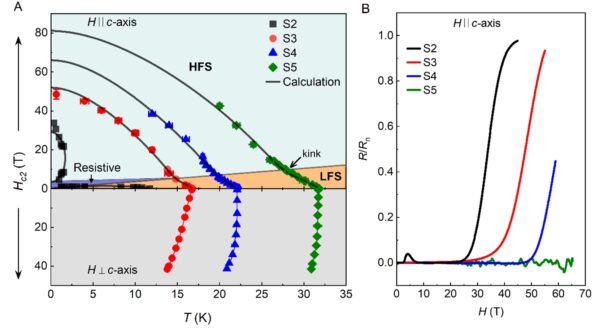
Figure shows (a) the field-temperature phase diagram of four Sm-based nickelate samples (S2 to S5), featuring both an expected low-field superconducting state (LFS, orange) and an unexpected high-filed superconducting state (HFS, green) (b) The magnetic response of resistance in the nickelates, demonstrating that as the magnetic field grows, resistance stays at near zero, which is the signature of superconductivity persisting beyond 60 T (in sample S5, green).[Credit: Nature Communications]
Dr Km RUBI, lead researcher at Los Alamos National Laboratory and NUS Physics PhD alumnus, said, “This work demonstrates that nickelates can sustain superconductivity in magnetic fields far beyond conventional limits. This opens a new frontier for high-field superconducting technologies.”
Dr King Yau YIP, co-first author and research fellow at NUS, added, “The success of Jaccarino–Peter compensation in capturing the magnetic response in Sm-based nickelates marks an important step towards understanding the physics underpinning nickelate superconductors.”
Prof Ariando said, “Our work shows that nickelates can sustain superconductivity far beyond conventional limits, but what excites us even more is the broader possibility this opens up. We see a path to pushing this concept toward even higher temperatures, including by exploring how it may be implemented in high-temperature cuprates. This is a bold and exciting next step, and one that could bring us closer to superconductors that operate under truly practical conditions.”
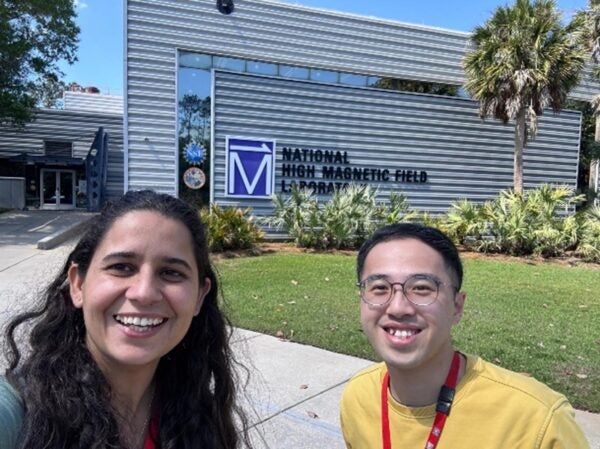
Photo taken at the National High Magnetic Field Laboratory, Tallahassee Florida. Left: Dr Km Rubi, scientist at the Los Alamos National Laboratory. Right: Dr King Yau Yip, research fellow at NUS Department of Physics.
Reference
Rubi K*; Yip KY; Krenkel E; Fitriyah N; Gao X; Prakash S; Chow SLE; Tang CS; Poon TF; Goh SK; Thomas SM; Dioguardi AP; Ayala-Valenzuela OE; Breese MBH; Chan MK; Graf D; Ariando A*; Harrison N, “High-field-stabilized reentrant superconductivity in infinite-layer nickelate thin films” Nature Communications DOI: 10.1038/s41467-026-75922-9 Published: 2026.