
Lower dose of abiraterone acetate as effective for prostate cancer treatment
July 22, 2025Pharmaceutical scientists, clinicians, nurses and pharmacists from the National University of Singapore (NUS) and National University Hospital (NUH) have shown that a reduced dose of abiraterone acetate is potentially as effective and safe as the standard regimen for prostate cancer patients.
Prostate cancer remains one of the most common malignancies among men. The current standard treatment involves a 1000 mg daily dose of abiraterone acetate (AA), a drug that targets hormone pathways driving cancer progression. However, this high dose can lead to unwanted side effects and high treatment costs.
The study, led by Professor Eric CHAN from the Department of Pharmacy and Pharmaceutical Sciences, NUS, and Associate Professor Edmund CHIONG, Head and Senior Consultant from the Department of Urology, NUH, and Senior Consultant, Division of Surgical Oncology, National University Cancer Institute, Singapore, investigated whether a 500 mg daily dose of AA, taken on an empty stomach, could achieve comparable therapeutic outcomes. In their study involving nine men with metastatic prostate cancer, they found that this lower dose resulted in comparable cancer suppression. This was demonstrated through reduced prostate-specific antigen (PSA) levels, a marker of tumour activity, and effective hormone suppression, as supported by both patient data and computer-based pharmacological modelling.
The findings were published in the journal Cancer Communications.
This new dosing approach may allow patients to experience fewer side effects, lower their treatment costs, and maintain effective cancer control. It could also improve treatment access and adherence, especially for elderly patients or those with financial constraints.
The research found that 500 mg AA led to a PSA reduction in all patients after 12 weeks, with over 75% experiencing a drop of 50% or more. The lower dose treatment was generally safe and well tolerated. Importantly, advanced pharmacokinetic modelling showed that even at half the usual dose, over 80% of the drug’s target enzyme (CYP17A1) remained inhibited, indicating strong therapeutic activity. These findings build on prior research and support the feasibility of a scientifically guided, lower dose strategy.
The research team has launched a larger, long-term clinical trial to further validate these promising results.
Professor Chan and Associate Professor Chiong said, “Our findings open the door to more cost-effective and safer treatment for prostate cancer patients, with minimal compromise on efficacy.”
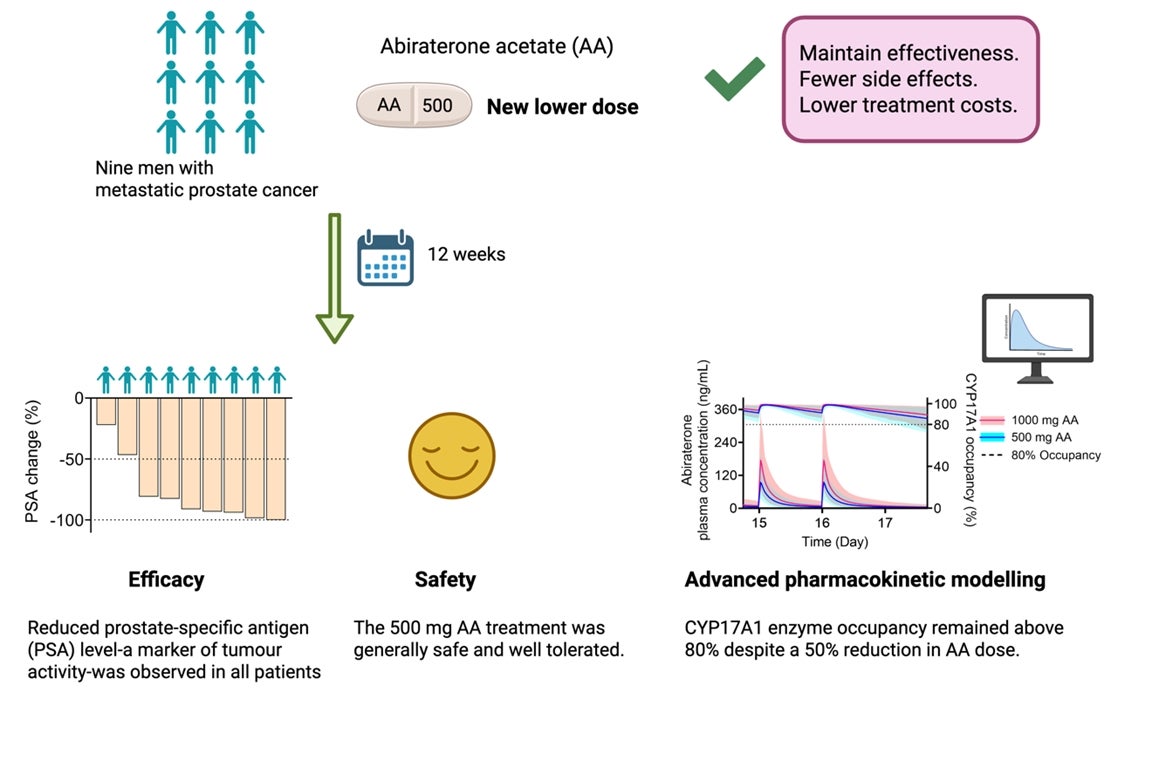
Clinical study design and research outcomes. (Bottom left) Low dose abiraterone acetate (AA) demonstrated reduced PSA levels-a marker of tumour activity. (Bottom middle) Safety profile suggested that low-dose AA was well tolerated during the 12-week treatment. (Bottom right) Modelling showed that even at half the usual dose of AA, over 80% of the drug’s target enzyme (CYP17A1) was still blocked.
Reference
Chiong E*; Wang Z; Cheong EJY; Yao YC; Tham SM; Periaswami R; Toh PC; Wang Z; Wu QH; Tsang WC; Kesavan A; Wong ASC; Wong PT; Lim F; Liu S; Chan ECY*, “Evaluation of exposure-response-safety relationship of model-informed low-dose 500 mg abiraterone acetate in prostate cancer patients” Cancer Communications DOI: 10.1002/cac2.70035 Published: 2025.