
Finding light in “dark” biodiversity
November 04, 2026Scientists from the National University of Singapore (NUS), collaborated with international partners in recording 120 species of fungus gnats in Singapore, 115 of which are new to science. These discoveries, based on a decade of sampling and collaboration between researchers from Singapore, Brazil, Germany and Norway, increased the number of known fungus gnat species in Southeast Asia by more than 25 percent – revealing how much biodiversity remains hidden even in a highly urbanised city-state, while demonstrating a new toolkit for discovering the planet’s most overlooked animals.
A decade of trapping across Singapore’s habitats
Fungus gnats are slender flies whose scientific family name, Mycetophilidae, means “fungus loving”. Being especially diverse in healthy forests, they are closely tied to the fungal networks that drive decomposition and nutrient cycling. Despite their ecological importance, they have long been overlooked in favour of more charismatic animals.
The study was hosted by Dr Yuchen ANG, Senior Curator of Insecta at the Lee Kong Chian Natural History Museum, NUS, working with Prof Dalton de Souza AMORIM of the University of São Paulo (Brazil) and collaborators from Germany and Norway. Published in the journal Integrative Systematics, the revision drew on 1,456 specimens primarily collected from 71 Malaise traps set at 107 sites between 2012 and 2019. Sampling spanned a wide range of habitats, from mangroves and swamp forests to primary rainforest and degraded urban green spaces. From this material, the team discovered 120 species across 23 genera, of which only five had been described before.
Bringing “dark taxa” into the light
Fungus gnats are a textbook example of what scientists call dark taxa, referring to groups of organisms so abundant and diverse that conventional identification, specimen by specimen under a microscope, simply cannot keep pace. Like dark matter, more is unknown than known: the 115 new species discovered in Singapore effectively increased the known diversity of fungus gnats in Southeast Asia by 25%.
To manage such volumes, the team used an approach known as dark taxonomy. Rather than manually examining the bodily structures of every specimen from the outset, they first sequenced a short piece of DNA from each fly – a “DNA barcode” that allowed large numbers of specimens to be sorted rapidly into likely species. They then verified those groupings by checking key physical features, finding strong agreement between the DNA results and what they observed under the microscope. The work also uncovered an entirely new genus, named Integricypta, an unexpected find that underscores how large the knowledge gaps for tropical fungus gnats remain.
Dr Ang said, “By establishing a baseline of species diversity and distribution, this study offers valuable data for long-term biomonitoring and forest health assessments, strengthening Singapore’s conservation planning and ecosystem management. Finding an entirely new genus was completely unexpected, and it really shows just how large the knowledge gaps for tropical fungus gnats still are.”
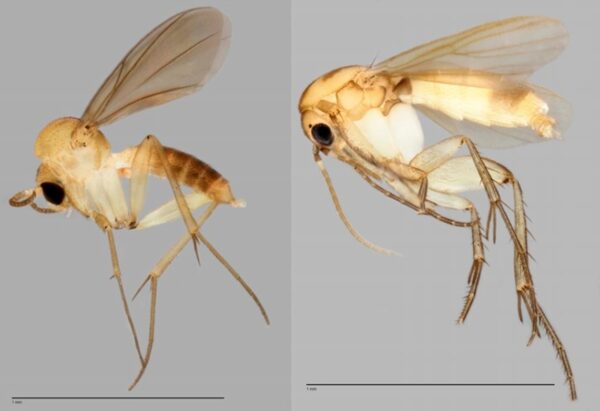
Two of the 115 newly described fungus gnat species: Azana leekongchiani (left), named after philanthropist Lee Kong Chian, and Mycetophila georgettechenae (right), named after pioneering Nanyang-style painter Georgette Chen. (Scale bars: 1 mm) [Credit: Lee Kong Chian Natural History Museum]
Honouring Singapore’s heritage and trailblazing women
The study also carries a cultural dimension, with many species named after figures who shaped Singapore. Azana leekongchiani, for instance, honours Lee Kong Chian, the philanthropist after whom the Lee Kong Chian Natural History Museum itself is named. Many of the newly described species also pay tribute to women inducted into the Singapore Women’s Hall of Fame, an initiative of the Singapore Council of Women’s Organisations that celebrates trailblazers across fields such as the arts, education, healthcare, public service and social development. The naming also addresses a long-standing imbalance.
Dr Ang said, “Historically, many species tend to be named after men. This approach is intended as a modest step toward greater gender parity.”
More discoveries to come
The 115 new species are unlikely to be the end of the story. Preliminary analysis of DNA barcodes from a second batch of specimens already hint at further species awaiting description, and the team estimates that around 85 per cent of Singapore’s Malaise-trappable fungus gnat fauna has now been documented. Dr Ang intends to expand the work with fungus gnat experts from Norway and the Czech Republic, and to begin tackling another family, Keroplatidae, which he notes may be trickier to study but are fascinating because some are predatory. Small and easily overlooked, fungus gnats are nonetheless a major part of Singapore’s biodiversity, and a clear reminder of how much remains to be discovered when we look beyond the usual headline animals.
Reference
Amorim DS; Oliveira SS; Balbi MIPA; Ang Y; Torres A; Yeo D; Srivathsan A; Meier R, “An integrative taxonomic treatment of the Mycetophilidae of Singapore reveals 115 new species from just 730 km2 (Diptera: Bibionomorpha)” DOI: 10.18476/2025.752376 Published: 2025.