
Mouse-deer population booms in Pulau Ubin after African Swine Fever reshapes the forest
October 07, 2026Researchers from the National University of Singapore (NUS) have found that the greater mouse-deer population on Pulau Ubin has surged to the highest density ever recorded for the species, likely driven by an African Swine Fever outbreak that decimated the island’s wild pigs. The finding offers a striking example of how a single disease event can ripple through a forest ecosystem and reshape the balance between species.
A quiet comeback in a rewilding city-state
Singapore has been described as a natural rewilding experiment, where decades of habitat restoration have allowed animals once thought lost to return. Among them is the greater mouse-deer, a small, shy forest ungulate that was rediscovered on Pulau Ubin after an absence of more than 80 years and is listed as Critically Endangered in Singapore. Despite its return, little was known about how large the population had grown or what was driving its recovery.
The study was led by Dr Marcus CHUA, Curator of Mammalia at the Lee Kong Chian Natural History Museum, NUS, in collaboration with the National Parks Board and George Mason University in the United States. The findings were published in the journal Biological Conservation.
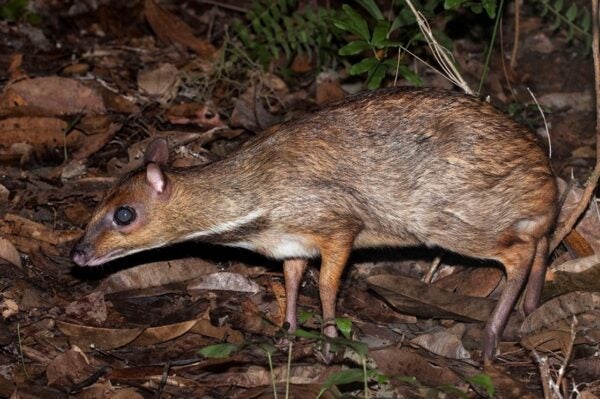
The greater mouse-deer (Tragulus napu), a small, shy forest ungulate once absent from Singapore for more than 80 years, has surged to the highest density ever recorded for the species on Pulau Ubin. Night-time spotlighting surveys, which detect the animals’ eyeshine, were one of two methods used to track the population. [Credit: Marcus Chua]
A disease outbreak with unexpected consequences
In 2023, an outbreak of African Swine Fever swept through Pulau Ubin, killing more than 98 per cent of the wild pigs on the island. Wild pigs are large, omnivorous animals that compete with mouse-deer for food and may even prey on them and their young. When their numbers collapsed, the mouse-deer appeared to flourish in their absence.
To measure the change, the team combined two survey methods over a 15-year period: night-time spotlighting along forest transects, where observers detect the eyeshine of animals, and camera traps set out across the island. Both approaches pointed to the same conclusion. Using transect data, the researchers estimated a density of 293 greater mouse-deer per square kilometre, at least three times higher than any density known for the species elsewhere in its range. Sightings of the animals rose more than fivefold in the five years spanning the outbreak.
Reduced competition, a restored forest, and few predators
The team attributes the boom to a combination of factors: reduced competition following the wild pig die-off, ongoing forest restoration that has seen more than 40,000 trees planted across the island, and low predation and poaching pressure. Greater mouse-deer are also prolific breeders, with short gestation and the ability for females to conceive again immediately after giving birth, allowing the population to expand rapidly once conditions turned favourable.
The researchers also found evidence that mouse-deer numbers had been climbing more gradually even before the outbreak, more than doubling between 2009 and 2019, supported by decades of vegetation recovery after granite quarrying and farming ceased on the island. As part of the work, the team developed and validated a model that converts simple transect sighting rates into density estimates, offering a lower-cost tool for conservation monitoring where full surveys are not feasible.
Dr Chua said, “The sharp rise in greater mouse-deer density following the African Swine Fever outbreak highlights significant ecological cascades and underscores the complex interplay between species and their environment. Long-term monitoring is essential if we are to understand the broader ecological consequences and inform conservation strategies for rapidly changing tropical landscapes.”‘
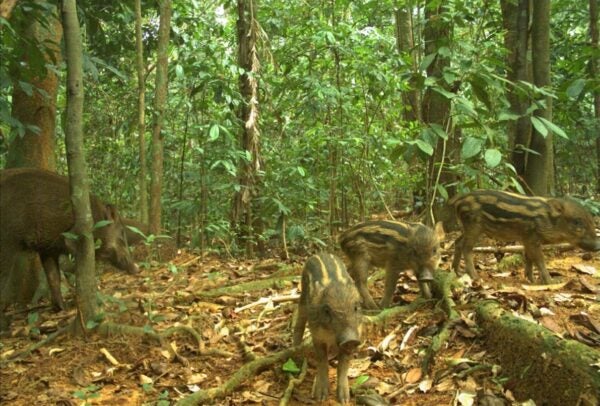
A camera trap captures a family of wild pigs, including striped piglets, on Pulau Ubin. The presence of young animals confirms that the wild pig population is breeding and re-establishing a year after the African Swine Fever outbreak, raising questions about future competition with the greater mouse-deer. [Credit: Marcus Chua]
Watching what happens next
The wild pig population has already begun to re-establish and is breeding again, raising questions about how the two species will interact as pig numbers recover and whether competition will intensify once more. The team emphasises the need for continued monitoring of both the ungulate populations and the forest itself, to reveal how such sudden shifts play out in restored habitats and to guide biodiversity conservation in an increasingly human-modified world.
Reference
Chua MAH*; Thomas N; Teo RCH; Lim HC, “Rapid population growth of greater mouse-deer after active forest restoration and African Swine Fever outbreak” Biological Conservation Volume: 313 Page: 111564 DOI: 10.1016/j.biocon.2025.111564 Published: 2026.