Reimagining patient care with AI
March 16, 2026He still remembers the quiet frustration of sitting in a clinic, as a patient navigating the uncertainties of his own chronic health condition. The long, exhausting cycle of referrals, tests and waiting rooms left a deep impression. It was there that Cheow Jun Wei’s interest in precision medicine first took root – a field that combines artificial intelligence (AI) and genomics to tailor treatments for the individual.
“That vision of healthcare – personalised, efficient and guided by data – aligned perfectly with the future of healthcare that I believe in,” he says.
Determined to build the technical foundations to contribute meaningfully, he chose to study Data Science and Analytics to understand how clinical data could be transformed into robust AI models. But algorithms built in isolation felt incomplete. To see how theory met practice, Jun Wei decided to take up a research attachment at Khoo Teck Puat Hospital.
Where theory meets reality
At the hospital’s Breast Centre, Jun Wei contributed to REBORN, a digital tool supporting patient education in breast surgery. Conducting qualitative interviews with patients, he had the opportunity to listen to their stories of vulnerability, fear and the difficult choices they faced. He watched them struggle to understand complex medical information within limited consultation time.
At the same time, he observed clinicians walking a tightrope – offering enough detail for informed consent, yet keeping explanations concise enough to fit into a packed clinic schedule.
Beyond patient education, Jun Wei worked on an early prototype for TESLA-G, experimenting with prompt engineering to train a large language model to generate exam-grade multiple-choice questions. The goal was practical: using AI to reduce the teaching burden on already stretched clinicians.
“Through this internship, I saw the full lifecycle of a medtech product unfold,” he says. “It begins not with code, but with on-the-ground realities, moving from observation to become an innovation that is tangible, tested and capable of changing practice.”
 |
 |
Data modelling for real-world complexity
The question began to preoccupy him: how to design models that are both robust and adaptable? When he began working with AI models, the tension between theory and reality stood out. In theory, more data yields better performance. In practice, more data can lead a model into “overfitting” – excelling on paper but faltering when confronted with the variability of real patients.
Healthcare, he realised, leaves little room for such fragility. A false positive is not just a statistical error; it is anxiety and unnecessary procedures. A false negative could mean a missed tumour or a delayed diagnosis.
“It’s not about maximising one metric,” he says. “It’s about balancing precision, recall and specificity, depending on context.” His training taught him to evaluate these trade-offs systematically and to define success not by technical sophistication alone – but by offering a solution that survives real-world complexity and supports both patients and clinicians.
 |
 |
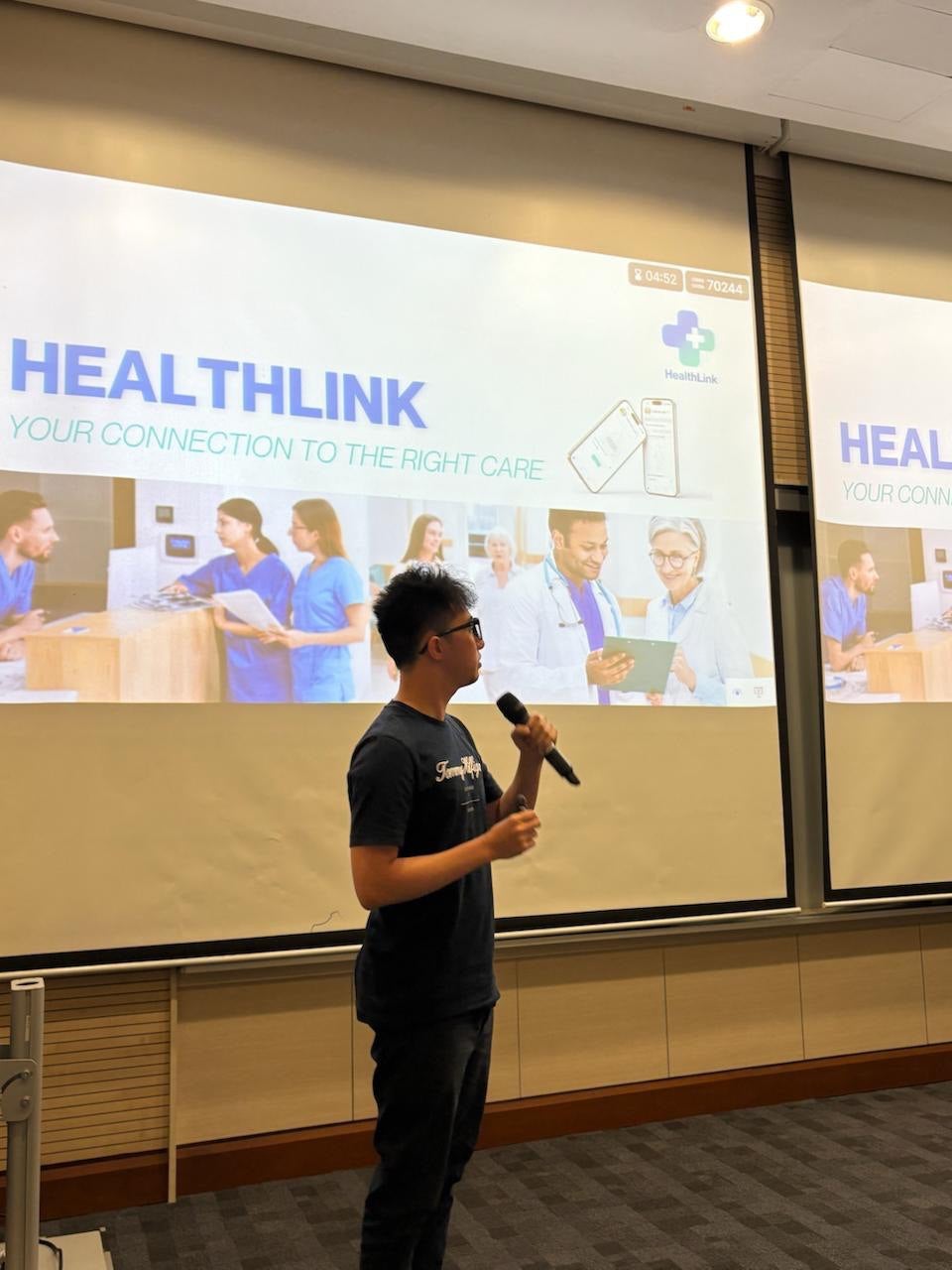
The seed for HealthLink
At the same time, his social media feeds were flooded with headlines about AI predicting diseases years in advance. This led to a new question: what if AI could also guide patients through the healthcare system itself?
That question became the seed for his own innovation – HealthLink.
Designed for patients with chronic conditions – individuals living with fluctuating symptoms and constant uncertainty – HealthLink aims to answer their practical questions: Is this flare manageable by a GP? Does it require a specialist? Or is it urgent enough for A&E?
By integrating longitudinal data – medical records, imaging scans, family history and past hospital visits- the AI-powered triage assistant analyses patterns across data points and suggests the most appropriate level of care.
In short, HealthLink’s differentiator lies in combining AI capabilities with a patient-journey perspective. By offering clarity early – HealthLink seeks to ease patient anxiety, reduce unnecessary emergency visits and free up clinicians to focus on the most urgent cases.
From prototype to practice
But moving from concept to implementation revealed harder truths. At some point, the technical questions gave way to harder, more uncomfortable ones. Why would the Ministry of Health pay a startup for a triage solution if it could build one internally? What would make HealthLink truly useful rather than merely innovative?
It was a sobering lesson. Translating an AI prototype into a real-world solution, Jun Wei discovered, is not just about technical refinement. It is also an exercise in alignment – of incentives, stakeholders, budgets and trust.
That insight reshaped his approach and the lessons stayed with him. HealthLink may be powered by a large language model, but its creation was never just about computation. It was rooted in clinical reality, shaped by data science rigour and softened by communication principles that made its approach more humane.
“I learned to think like a data analyst, observe like a clinician and speak like a communicator, all at once,” he says.