
Beyond algorithms: AI for science in practice
June 16, 2026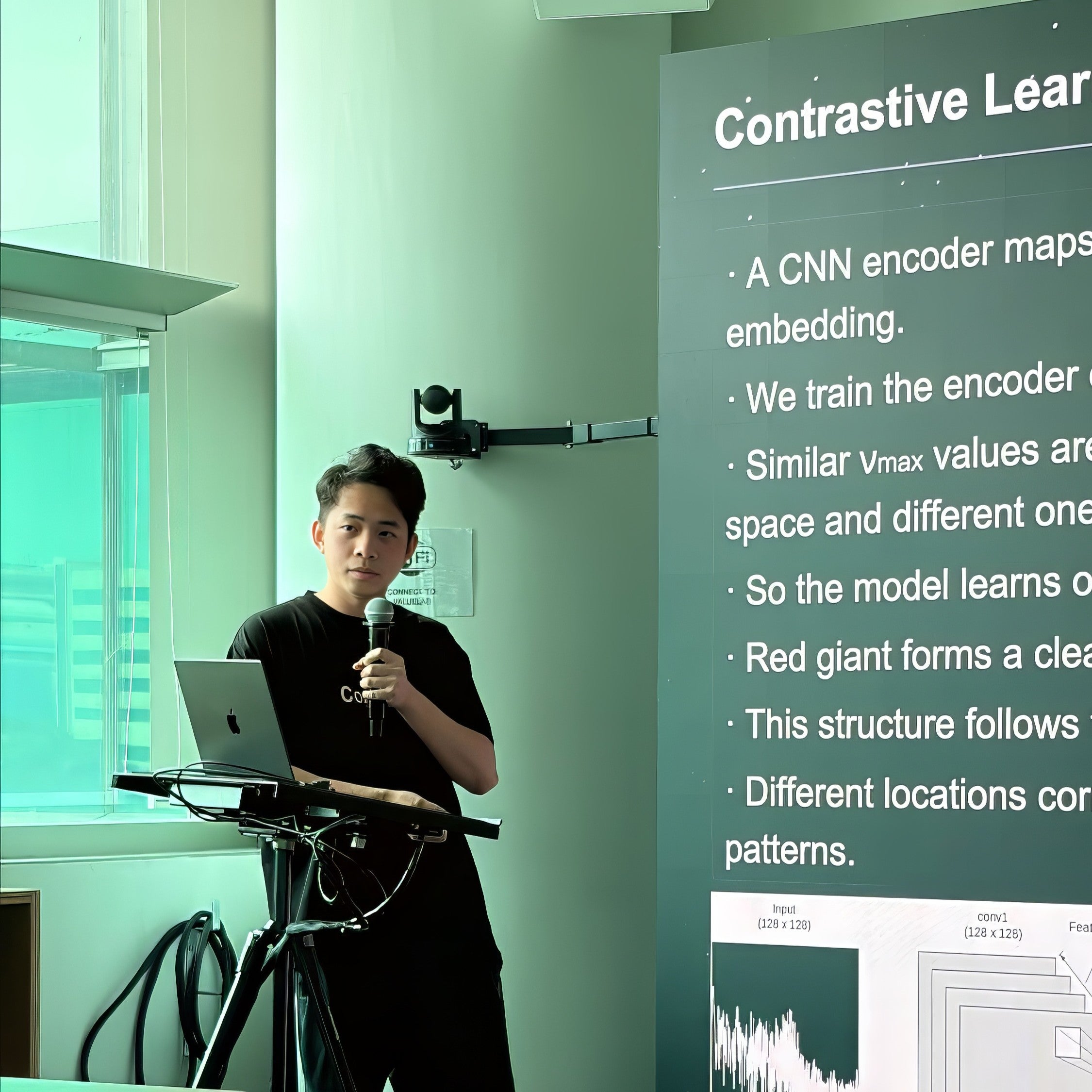
When Lin Yihan received an offer to join Shopee Singapore as a Data Analyst intern, it marked more than a successful internship search. It was the culmination of a colourful learning journey that started from chemistry classrooms and which pivoted to his interest in physics and mathematical theory, and ultimately, real-world data systems.
What set him apart in the recruitment process was not merely technical proficiency, but what he describes as “the scientific rigour, critical thinking and data hygiene crucial to navigating chaotic, large-scale commercial pipelines” – capabilities he honed through the MSc AI for Science programme at the Faculty of Science.
Today, Yihan is applying the same principles of careful verification, analytical thinking and interdisciplinary problem-solving to commercial data challenges at one of Southeast Asia’s largest technology companies.
Following curiosity, across disciplines
During his studies, while mathematics sharpened his logical thinking, astronomy remained his enduring passion. Fascinated by the mysteries of the universe, he gravitated towards projects that combined machine learning with astronomical research.
“I love the universe, I love physics and I love the imagination surrounding the starry sky, civilisations and unknown worlds in science fiction,” he says.
The MSc AI for Science programme, especially the AI for Astrophysics course, offered the unique convergence of his interests – where mathematics, machine learning and astrophysics could be meaningfully brought together within a single academic framework.
Discovering the perfect intersection
For Yihan, the decision to apply for the programme was immediate – it represented the interdisciplinary bridge between his technical skills and long-held fascination with the cosmos he had been seeking.
That bridge soon took concrete form as Yihan ventured into asteroseismology, the science of “listening” to giant ageing stars, known as red giants, through their oscillations. Deep inside them, sound waves bounce around and cause tiny flickers in their brightness, like the vibrations of a giant cosmic bell. Drawing on data from NASA’s Transiting Exoplanet Survey Satellite (TESS), Yihan used machine learning to recognise red giants based on the unique “fingerprints” of their flickering lights – like identifying a song from its waveform.
But there was a catch: TESS only observes a patch of sky for about 27 days. Many stars leave partial or faint signals, and even existing records are not always accurate. Instead of building another AI model for these records, Yihan decided on a different approach. He designed a smart, three-step sorting system that groups similar stars together, flags stars whose records disagree with their closest peers and assigns each star a confidence score. The result does more than just identify the red giants: it tells astronomers which discoveries are highly reliable, borderline or which deserve a closer inspection.
Yet, the transition to research was far from straightforward. He had to quickly build fluency in astronomical datasets, domain knowledge and research methodologies, largely from scratch. Unlike structured coursework, scientific research demanded continuous exploration, iteration and adaptation.
Over time, this challenge became one of the programme’s most formative experiences for him. As his research progressed, he arrived at a crucial insight: AI is only as meaningful as the scientific questions it seeks to answer. This perspective fundamentally changed the way he approached problem-solving.
“AI for science requires us to first understand the underlying scientific problem itself and then determine the role AI can play within it,” he says.
The programme’s curriculum reinforced this philosophy by balancing theoretical depth with applied practice. Through his research, Yihan learned to align data science techniques with astrophysical realities, ensuring that technical models remained scientifically grounded.
He gradually evolved from executing tasks to actively contributing ideas and shaping research directions alongside his supervisor. What began as a course requirement grew into a sustained commitment for Yihan, who chose to remain involved after the two-semester project concluded, manually vetting a trusted reference set of stars to further sharpen the model’s calibration. “It was not just a course project experience but a genuine opportunity to get close to astronomical research.”
At the same time, his exposure to scientific datasets sparked a new question: if even carefully curated astronomical catalogues are noisy, uncertain and incomplete, what would data look like in a business environment?
Inside Shopee’s data ecosystem
That question followed him to his internship at Shopee, where Yihan now encounters a fundamentally different type of data environment.
Instead of astronomical observations, he finds himself navigating enterprise-scale data pipelines, business metrics and operational systems. Understanding how data flows – from upstream sources through multiple transformations before appearing in dashboards – is central to his role.
His responsibilities include metrics verification, troubleshooting and data migration. When discrepancies arise, he traces metrics back to their origins, examines calculation logic and verifies how outputs are ultimately presented to stakeholders.
He now uses AI tools in a more applied and pragmatic way. From unpacking complex SQL (Structured Query Language) logic to structuring verification checklists or organising the context and communication of an issue, AI helps him break down information and accelerate his thinking. At the same time, the final judgement remains firmly human – reconciling business definitions with data and ensuring conclusions are sound.
The experience has reshaped his understanding of analytics. “Data analysis is not just about writing SQL to get results. It is about understanding the business meaning behind the data and ensuring every step is reliable.”
The scientific discipline cultivated during his studies proved directly transferable. Be it analysing astronomical observations or validating business metrics, the underlying process remains consistent: define the problem clearly, question assumptions and transform complex data into trustworthy insight.
Human judgement in an AI-driven world
Looking ahead, Yihan points to emerging developments such as foundation models for science and automated data curation as the next frontier.
As AI systems become more capable of writing code, analysing formulas and generating outputs, he believes human value will increasingly lie in critical judgement: asking the right questions, safeguarding data integrity and translating insights across disciplines into meaningful action.
In many ways, this conviction reflects his own journey. From the sciences to industry, the throughline remains constant: the power of AI lies not simply in what it can do, but in the questions it is used to answer.