Physics-informed Artificial Intelligence (AI) to decode gravitational waves from supermassive black-hole pairs
October 22, 2026Researchers from the National University of Singapore (NUS) have developed an artificial intelligence (AI) framework to decode gravitational waves (ripples in space-time) from orbiting, inward-spiralling pairs of supermassive black holes in distant galaxies. The framework uses timing signals from distant pulsars (rotating neutron stars that act as precise cosmic clocks). By building the known physics of the black holes’ orbital motion directly into the AI model, the framework produces more precise and reliable estimates than purely data-driven AI approaches, while enabling rapid analysis of new datasets after training.
Cosmic clocks: The challenge of decoding gravitational waves
Pulsars are rapidly spinning neutron stars that emit radio pulses with extraordinary regularity, making them highly precise natural clocks. Gravitational waves passing through the Galaxy cause tiny, correlated shifts in the arrival times of these pulses. By monitoring dozens of pulsars over many years, international pulsar timing array (PTA) collaborations have recently found strong evidence for a background of low-frequency gravitational waves. Pairs of supermassive black holes formed through galaxy mergers are considered the leading candidate source of these waves. The next milestone is to identify individual black-hole pairs and determine their properties. However, the signal from a single pair is weak, spread across observations of many pulsars collected over more than a decade, and entangled with background noise.
Traditionally, these signals are analysed using statistical Bayesian methods, which infer the source properties and their uncertainties by comparing possible signals with the observations. Conventional sampling-based Bayesian methods have to evaluate the signal model an enormous number of times to assess its agreement with each new dataset, making the analysis increasingly computationally demanding as PTA datasets continue to grow in size and complexity.
The study was conducted by Assistant Professor Alvin CHUA, from the NUS Departments of Physics and Mathematics together with Dr Subhajit DANDAPAT, a Postdoctoral Research Fellow at the NUS Department of Physics. The team developed an AI framework that combines Transformers, the architecture behind modern large language models, with simulation-based inference (SBI), a technique that trains AI models to estimate physical properties and their uncertainties using large numbers of simulated observations.
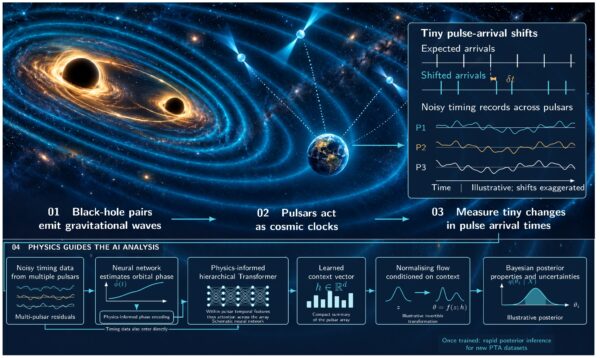
Overview of the physics-informed AI framework. Gravitational waves from a black-hole pair cause tiny shifts in pulsar signals’ arrival times. Guided by the black hole’s estimated orbital phase, a Transformer summarises timing data across the pulsar array. A generative model then infers the black-hole pair’s properties and their uncertainties. Once trained, the framework rapidly analyses new datasets. [AI-generated cosmic artwork; illustration not to scale and curves are schematic.]
Building physics into the AI
A key innovation is a physics-informed positional encoding, which incorporates knowledge of physical laws into the AI model. Standard AI models known as Transformers identify patterns in data but do not necessarily account for the physical laws behind them. The team augmented this with information about the orbital motion of the black-hole pair, which governs how the gravitational-wave signal changes over time as the black holes move in eccentric, or elongated, orbits. As the exact positions of the black holes along their orbits cannot be observed directly, a dedicated neural network first estimates it from noisy pulsar timing data. This information then guides the AI in analysing the gravitational-wave signals.
The Transformer analyses the timing data in two stages, first identifying patterns from each pulsar’s timing record and then combining information across the entire array. A learned mechanism allows the model to rely less on the phase information when the estimate is uncertain. The resulting summary is passed to another AI model, known as a normalising flow, which produces probability distributions describing the likely values of the binary’s properties (including its masses, orbital frequency, eccentricity and sky location) and their uncertainties. Once trained using millions of simulated pulsar signals, the AI framework can rapidly analyse new datasets without repeating the lengthy calculations required by traditional methods.
Sharper insights into black hole properties
Compared with a baseline AI model without the physics-informed encoding, the new framework produced more precise estimates and was better able to identify the actual parameter values in simulated tests. It also improved the reliability of its uncertainty estimates, reducing the average discrepancy between expected and observed coverage by about 35%. When trained on very large datasets, its results were consistent with those from conventional Bayesian analysis. The improvements were greatest when training data were limited, which is an important advantage as realistic simulations are costly to generate.
Assistant Professor Chua said, “As pulsar timing arrays accumulate larger and more complex datasets, conventional analysis methods are becoming increasingly difficult to scale. Our work shows that building physical knowledge into AI models allows them to learn more efficiently and produce results that scientists can trust. This could help scale analysis for the next generation of gravitational-wave searches, which is essential if AI is to become a reliable tool for discovery in astrophysics.”
Looking ahead, the team plans to extend the framework to more realistic PTA data that account for different noise sources and other gravitational-wave signals.
The research also demonstrates a broader opportunity for AI in science: combining machine learning with established physical laws to solve complex problems more efficiently and reliably. As international collaborations gather data from an increasing number of pulsars and next-generation radio telescopes come online, the approach could help scientists analyse larger and more complex datasets.
Reference
Dandapat S*; Chua AJK, “Transformers with Physics-Informed Encodings and Simulation-Based Inference for Robust Detection of Eccentric Binary Black Holes in Pulsar Timing Array Data”. AI4X – Accelerate Conference 2026. OpenReview: https://openreview.net/forum?id=Bpo4HgB6by. Preprint DOI: 10.48550/arXiv.2607.03904. Published: 2026.