
Artificial Intelligence (AI) methods to discover hidden rules governing material behaviour
July 23, 2026Researchers from the National University of Singapore (NUS) have developed artificial intelligence (AI) methods that learn the large-scale behaviour of complex materials from microscopic data. By automatically identifying a small number of hidden variables that capture the collective behaviour of a system, the methods can predict the way materials evolve over time while reducing the need for costly simulations.
From atoms to materials: A computational bottleneck
Understanding the behaviour of materials at the macroscopic scale is essential for designing new technologies, from energy-efficient electronics to advanced alloys. However, material properties emerge from the interactions of vast numbers of atoms, and simulating every atom over long periods of time is often computationally impossible, even on modern supercomputers. A major challenge in materials science is connecting these microscopic processes, such as atomic motion, to observable material properties. Existing approaches often require large-scale simulations that are prohibitively expensive.
The research team was led by Associate Professor Qianxiao LI from the NUS Department of Mathematics. The team developed new artificial intelligence methods that learn the large-scale behaviour of complex physical systems directly from microscopic observations. Instead of tracking every individual particle, the methods identify a small number of hidden variables that capture the collective behaviour of the system and predict the evolution of these quantities over time.
The research breakthroughs were reported in two studies, one published in the journal Physical Review Materials and the other presented at the International Conference on Machine Learning (ICML) 2026.
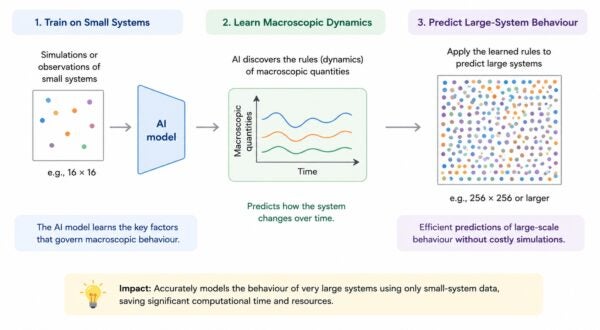
Overview of the AI-driven approach. The model is trained on data from small systems containing a limited number of particles (left). It then identifies the key quantities and rules that describe the system’s large-scale behaviour (centre). Once learned, these rules can be applied to predict the behaviour of systems many times larger than those used in training (right), saving significant computational time and resources. [Image generated using AI tool]
Two breakthroughs, one unified goal
One breakthrough allows accurate prediction of the behaviour of very large stochastic systems using only simulations performed on much smaller systems. Instead of computing the forces acting on every atom in a large system, the new methodology uses information about the forces from a small fraction of the atoms to learn the way the whole system behaves. The team proved mathematically that this shortcut still leads to accurate models and validated it on systems ranging from biological population models to simulated alloys containing over 500,000 atoms.
The second breakthrough enables AI models to learn from systems such as fluids, particle assemblies and polymers, where the microscopic components have no natural ordering. The AI handles this by learning the overall pattern of the way particles are spread out, rather than trying to track each one individually. This means the model produces the same result regardless of the order in which the particles are labelled.
Together, these advances allow researchers to build efficient macroscopic models from microscopic data while preserving the essential physics of the system.
Scalability and flexibility
A key advantage of the approach is scalability. The methods can infer the behaviour of systems much larger than those used during training, opening the possibility of studying realistic materials at scales that were previously inaccessible. The framework is also flexible enough to handle particle-based systems whose microscopic structure lacks a fixed ordering, making it applicable to a broad range of scientific problems.
Associate Professor Li said, “Many important scientific problems involve understanding the ways in which large-scale behaviour emerges from countless microscopic interactions. Our goal is to develop AI methods that can automatically discover these effective laws, allowing researchers to study complex systems with dramatically lower computational cost while retaining physical accuracy.”
Looking ahead, the team plans to integrate these methods with experimental data and more advanced materials simulations, especially those at the mesoscopic scale. The long-term goal is to create AI tools that can rapidly predict material behaviour and accelerate the discovery of new materials for energy, electronics and manufacturing applications.
References
Chen M; Huang P; Novoselov KS; Li Q*, “Scalable Learning of Macroscopic Stochastic Dynamics” Physical Review Materials Volume: 10 Issue: 3 Page: 033805 DOI: 10.1103/mlh4-htxv Published: 2026.
Han Z; Chen M; Li Q*, “Learning Permutation-Invariant Macroscopic Dynamics” Proceedings of the 43rd International Conference on Machine Learning (ICML) PMLR DOI: 10.48550/arXiv.2605.30812 Published: 2026.