
NuSAP: The “centriole bodyguard” of the cell
March 12, 2026Biologists at the National University of Singapore (NUS) have uncovered how the protein NuSAP safeguards tiny structures inside cells called centrioles, revealing a mechanism linked to developmental disorders such as microcephaly and mosaic variegated aneuploidy (MVA) syndrome.
Cells rely on tight control of the centrosome, a small “control centre” that helps organise cell division, to make sure each new cell receives the correct set of genetic instructions during division. If centrosome regulation is disrupted, the cell can form abnormal division structures and mishandle chromosomes, leading to errors that may contribute to developmental problems or disease.
A research team led by Associate Professor LIOU Yih-Cherng from the NUS Department of Biological Sciences found that the microtubule-associated protein NuSAP plays a critical role in stabilising centriole architecture and coordinating the recruitment of proteins necessary for proper centrosome engagement.
The findings were published in the journal Advanced Science.
Dr ZHANG Shiyu, a Research Fellow on the team, said, “Accurate cell division is fundamental to human development. Our study shows that the protein NuSAP acts as a guardian of centrosome integrity. When this protection fails, chromosome errors can accumulate, a hallmark of disorders such as microcephaly and MVA syndrome.”
Why centriole integrity matters
Each time a cell divides, it must faithfully duplicate and distribute its genetic material. This process depends on centrosomes, which organise microtubules and form the mitotic spindle. At the core of each centrosome are two centrioles that must remain tightly “engaged” after duplication and only separate at the correct stage of the cell cycle.
If this coordination fails, cells can develop abnormal centrosome numbers, chromosome mis-segregation, and genomic instability, leading to defects associated with developmental disorders and cancer. However, how centriole structural integrity is preserved has remained incompletely understood.
A newly identified structural safeguard
The research team discovered that NuSAP, previously recognised for its role in spindle organisation during mitosis, also functions earlier in the cell cycle to protect centriole structure. Using super-resolution imaging and biochemical approaches, they found that loss of NuSAP damages the centriole’s internal scaffold, disrupts the surrounding support material, and causes the centriole pair to separate too early.
Importantly, NuSAP was shown to be required to bring in a key “ring” of helper proteins (CEP57–CEP63–CEP152 torus complex) that wraps around the centriole and helps keep the two centrioles attached until the right time. The study also showed that NuSAP physically binds to one of these helper proteins, called CEP57, and helps position it early on, just before the cell enters division.
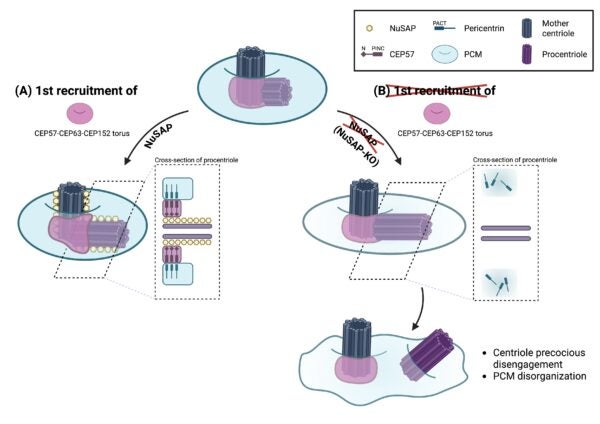
A two-step recruitment model based on the findings for the CEP57-CEP63-CEP152 complex during a single cell cycle. (A) During S to G2 phase, CEP57 is gradually recruited to the procentriole, crucial for precise engagement between mother and procentrioles. This recruitment process is finely regulated by NuSAP and centriolar structural integrity. (B) In the absence of NuSAP, with centriole tubulin instability, CEP57 recruitment to procentrioles during S to G2 phase is impaired, leading to disorganized pericentriolar material (PCM) structure and premature centriole disengagement. [Created in BioRender. Liou Y. (2026) https://BioRender.com/pbzrubb]
Bridging basic biology and disease mechanisms
Defects in centrosome regulation are implicated in conditions such as microcephaly and tumorigenesis. By clarifying how centriole integrity is safeguarded at the molecular level, this study provides important mechanistic insight into how centrosome dysfunction may arise in human disease.
Associate Professor Liou said, “Our findings reveal that NuSAP acts as a structural guardian of centrioles, ensuring that key recruitment events occur in the correct order during the cell cycle. Understanding how centriole integrity is maintained will help us better understand the origins of diseases linked to centrosome dysfunction and genomic instability.”
The research team plans to further investigate how NuSAP-mediated centriole protection contributes to genome stability and whether defects in this pathway play broader roles in human diseases associated with chromosome instability.
Reference
Zhang S; Jiang Z; Yang Q; Zheng H; Wang M; Zhu C; Deng L-W; Crasta KC; Liou Y-C*, “NuSAP Safeguards Centriole Integrity to Mediate CEP57–CEP152 Torus Recruitment for Proper Engagement” Advanced Science DOI: 10.1002/advs.202515192 Published: 2026.