

Molecular target drive immunogenicity in cancer immunotherapy
March 05, 2026Researchers at the National University of Singapore (NUS) have identified a protein called tyrosine phosphatase 1B (PTP1B) as a potential “switch” that can modulate a type of cancer cell death known as immunogenic cell death (ICD).
ICD is a special type of regulated cell death that activates the body’s adaptive immune system against the dying cells. ICD-causing agents not only kill cancer cells directly but also help to develop long-term protection against them. This dual benefit has made ICD inducers and their drug mechanisms an increasingly important area of cancer research. While this has fuelled the search for these drugs in recent years, the specific molecular targets involved in ICD remained poorly understood.
A research team led by Professor ANG Wee Han from the NUS Department of Chemistry has discovered two platinum-containing compounds, namely Pt-NHC and PlatinER (Pt-ER) that can trigger ICD. In their research model study, tumour cells treated with these compounds were effective in helping to develop immunity protection against colorectal cancer. This work was carried out in collaboration with Associate Professor Maria BABAK from the City University of Hong Kong.
The research breakthrough was published in the Journal of the American Chemical Society.
To understand how Pt-ER works inside cancer cells, the researchers designed several light-activated probes based on Pt-ER that could “tag” the proteins it attaches to. By combining advanced protein analytical methods and statistical analyses, the team identified PTP1B as a direct protein target linked to ICD. The team showed that both Pt-ER and Pt-NHC directly bind to PTP1B and block its enzymatic activity, leading to ICD induction in cancer cells. Furthermore, they also found that interfering with PTP1B either by switching off the gene or using other PTP1B-blocking compounds, could similarly increase ICD in cancer cells. The results also agreed with analysis of public datasets, suggesting that PTP1B is involved in tumour growth and immune regulation in colorectal cancer.
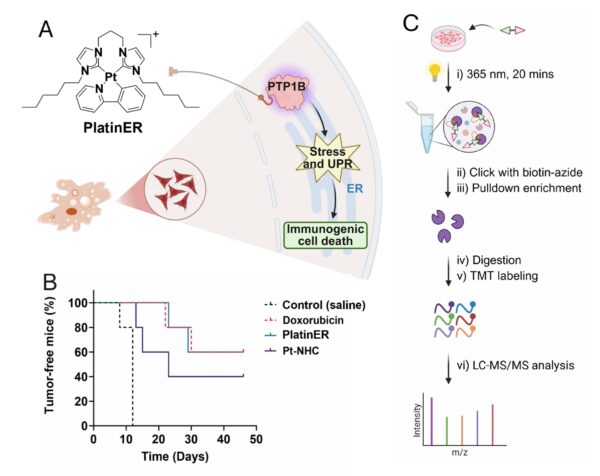
Figure (A) Mechanistic view of PlatinER induced ICD through PTP1B targeting. (B) Data illustrating ability of PlatinER and Pt-NHC to establish immunity against colorectal cancer in research models. (C) Schematic diagram illustrating target profiling processes, including photoaffinity labeling, click reaction, enrichment, tandem mass tags (TMT) quantitative proteomic analysis and target prioritization.
Overall, the study revealed for the first time that PTP1B plays an important role in regulating ICD and may be a promising target for cancer chemoimmunotherapy.
Prof Ang said, “The current study revealed the link between PTP1B and the immune-stimulating effects of our platinum-based ICD inducers. The next step is to understand how these molecules interact with PTP1B and trigger cell responses. Moving forward, we plan to follow-up with a more detailed structural and molecular dynamics study of PlatinER with PTP1B.”
Reference
Zou JX; Ivanov-Rostovtsev PA; Arakelyan J; Babak MV*; Ang WH*, “Organoplatinum(II) Type II Immunogenic Cell Death Inducers Target Protein Tyrosine Phosphatase 1B to Drive Immunogenicity” Journal of the American Chemical Society DOI: 10.1021/jacs.5c18904 Published: 2026 (Featured on front cover).