

Two-dimensional materials for next-generation terahertz quantum devices
January 21, 2026Scientists from the National University of Singapore (NUS) have discovered that atomic-scale substitutional dopants in ultra-thin two-dimensional (2D) materials can act as stable quantum systems operating at terahertz (THz) frequencies. This finding opens up new possibilities for realising high-temperature spin qubits and THz single-photon emitters.
Imperfections, or defects, in 2D materials are not always a drawback. In fact, certain defects can serve as tiny quantum systems. Some of these quantum defects host a property called a spin-triplet state, which makes them suitable as spin qubits. Spin qubits are the basic building blocks of quantum computers. In most known systems, the energy difference between spin states, known as the zero-field splitting (ZFS), typically lies in the microwave (gigahertz) range. While microwave technology is well developed, qubits that reply on microwaves tend to lose their quantum behaviour more easily at room temperature.
THz frequencies sit between microwaves and infrared light. Until recently, this range was known as the “THz gap” because it was difficult to generate and detect THz signals. However, rapid progress, driven in part by interest in future 6G communication technologies, has led to much better and more robust THz sources and detectors.
Quantum defects with a larger ZFS can potentially result in spin qubits that are more robust and can operate with high reliability at higher temperatures, when compared to the traditional qubits operating in the microwave regime. A research team led by Associate Professor Su Ying QUEK from the Department of Physics at NUS used first-principles high-throughput simulations to study 50 different systems based on 2D materials made by adding transition-metal atoms into monolayers of molybdenum disulfide (MoS₂) and tungsten diselenide (WSe₂). They identified several stable spin-triplet defects with exceptionally large ZFS values, in the THz range. This large energy splitting is primarily due to the strong coupling between the spin and the surrounding atomic structure, known as spin-orbit coupling.
The findings were published in the journal ACS Nano.
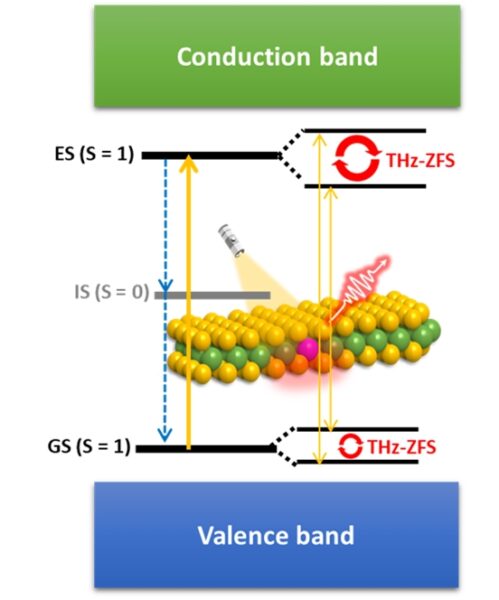 |
Schematic illustration of quantum terahertz (THz) qubits and emitters based on defects in two-dimensional (2D) materials. Black energy levels represent the spin-triplet states (S = 1) while the grey energy level represents a spin-singlet state (S = 0). These states are labelled as ground state (GS), excited state (ES) and intermediate state (IS). The figure illustrates the possibility of resonant optical control (yellow arrows) for a THz spin qubit, and the use of intersystem crossing (blue arrows) to control the population of the spin sublevels for a quantum emitter. [Credit: ACS Nano] |
Mr Jingda ZHANG, a PhD student on the research team said, “These results provide clear examples of solid-state defect systems which can potentially host spin qubits capable of functioning efficiently at higher temperatures in the THz regime. The atomically thin nature of these systems also facilitates integration with nanophotonic structures for future quantum THz technologies, which can span from THz spin qubits to THz single photon emitters.”
Prof Quek said, “The significance of this work is that it bridges two distinct research communities—quantum defect physics and THz photonics. Most spin-qubit research today focuses on microwaves, but our results suggest that looking into the THz regime could unlock new and powerful quantum technologies.”
Reference
Zhang JD; Quek SY*, “Quantum Defects in 2D Transition Metal Dichalcogenides for Terahertz Technologies” ACS Nano Volume: 19 Issue: 41 Page: 36204-36214 DOI: 10.1021/acsnano.5c06007 Published: 2025.