

A heart for healing: Prof Eric Chan’s quest to redefine cardiac care
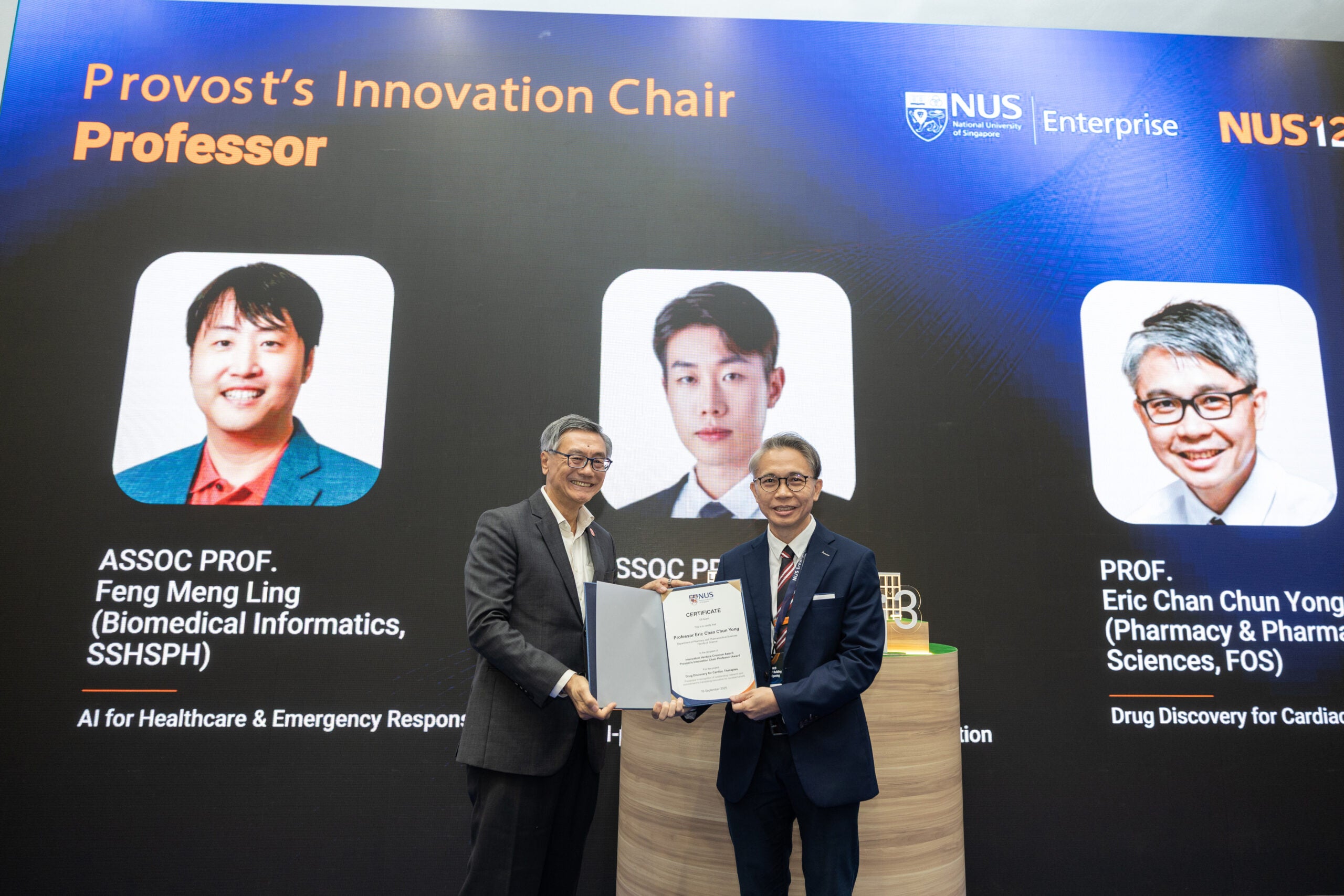
November 10, 2025Congratulations to Prof Eric Chan, Department of Pharmacy and Pharmaceutical Sciences, who received the Inaugural Innovation Venture Creation Award and Provost’s Innovation Chair Professor Award (2025), for his work on poyendarone, a new medicine for atrial fibrillation which is safer for the heart and other organs.

“My experience as a patient spurs me to identify breakthrough treatments.”
Having weathered not only heart disease but also glaucoma and other health battles, Prof Chan understands firsthand what it means to live with illness. For most of us, a health scare would be reason enough to slow down. But for Prof Chan, he has turned his personal health scares into a lifelong mission – developing safer, more effective medicines.
Atrial fibrillation: Hiding in plain sight
At the heart of his groundbreaking work lies poyendarone – a promising new drug candidate that could transform how doctors treat atrial fibrillation, a common and potentially dangerous heart rhythm disorder that raises the risk of stroke and heart failure. Current AF drugs, such as amiodarone and dronedarone, can be effective but come with a worrying list of side effects, from organ toxicity to ventricular arrhythmia.

Prof Chan and his team set out to address this unmet need. Their answer? Through chemical craftsmanship, otherwise known as deuteration. In simple terms, this involves replacing hydrogen atoms with deuterium atoms. This small yet significant step makes a big difference – it helps the drug work just as well, but without causing the same harmful reactions that have plagued older medications. The result is poyendarone, a next-generation therapy that could one day offer patients the treatment they need without the serious side effects.
Prof Chan’s approach marks a refreshing paradigm shift; while most researchers use deuteration to help drugs last longer in the body, he saw a different opportunity – to make them kinder to the body.
Pushing the boundaries of cardiac innovation
Prof Chan’s vision extends beyond poyendarone. In his laboratory, cutting-edge techniques – such as stem cell-derived human heart and gene editing – are used to uncover new ways to treat cardiac arrhythmias at their genetic roots. His team recently identified a genetic variant linked to heart rhythm instability and is now developing a method to correct it – an early but thrilling step toward potential gene therapy for cardiac arrhythmia.
A global patent for poyendarone has been granted in Japan and Singapore and is now under review across major markets namely, the United States, Europe, Canada, South America and China. With a licensing deal in the pipeline, the path toward clinical trials and eventual commercialisation is taking shape.