
Whale of a find: Lee Kong Chian Natural History Museum studies partial baleen whale carcass
September 29, 2025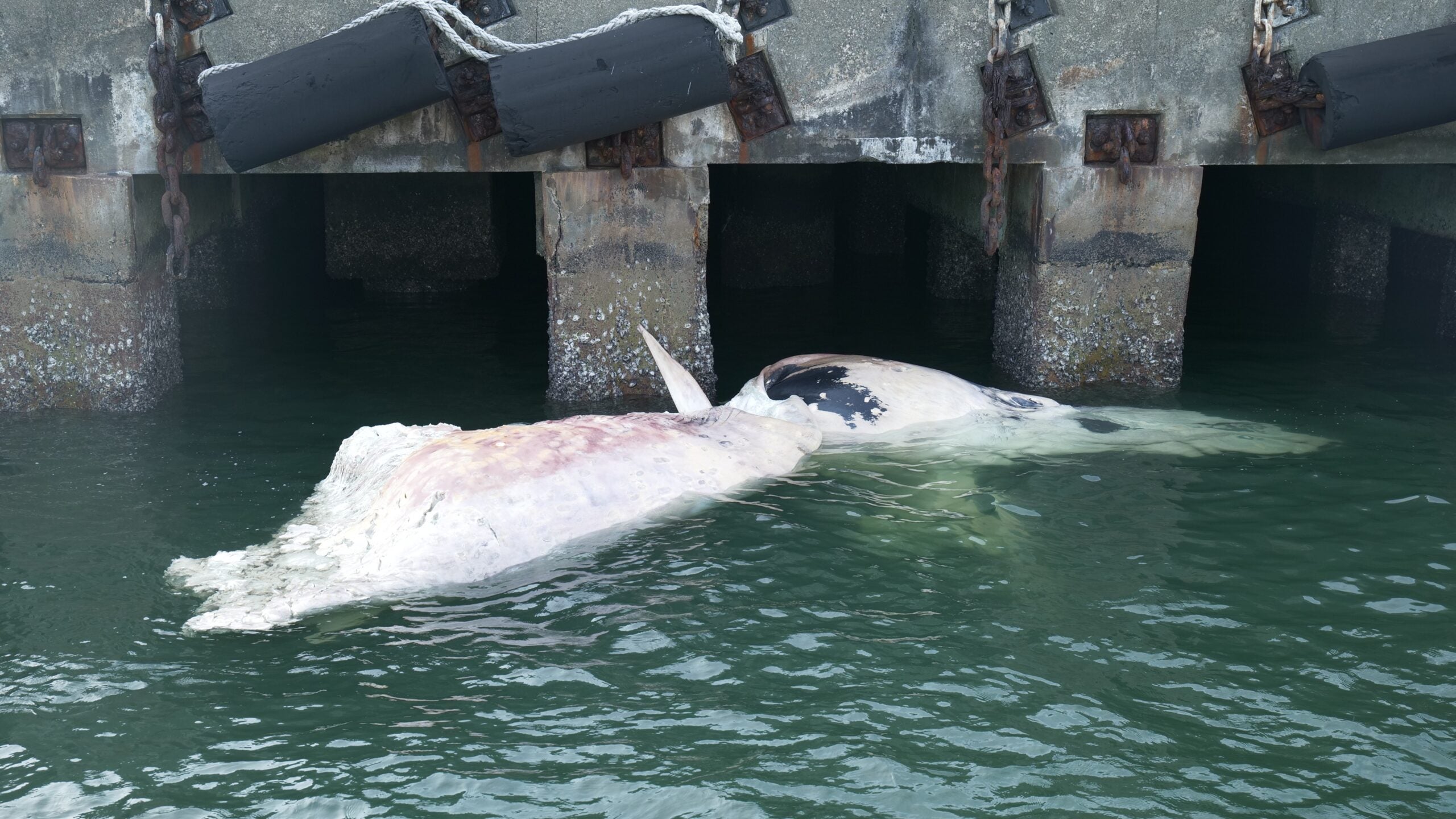
Floating whale carcass found in the waters off Tanjong Pagar on 6 September 2025. (Photo credit: Lee Kong Chian Natural History Museum, National University of Singapore)
A remarkable scientific undertaking is now in motion following the discovery of a baleen whale carcass in Singapore’s waters on 6 September 2025. Found floating in Singapore’s waters off Tanjong Pagar, this rare marine giant has been safely secured in a restricted area and is being studied by the Lee Kong Chian National History Museum (LKCNHM) of the NUS Faculty of Science.
“Preliminary assessment indicates that the whale carcass is at an advanced stage of decomposition and so the cause of death is unclear,” said Dr Marcus Chua, Curator of Mammalia at LKCNHM, who is leading the operation. “Meanwhile, we are working to find out as much as we can about the animal.”
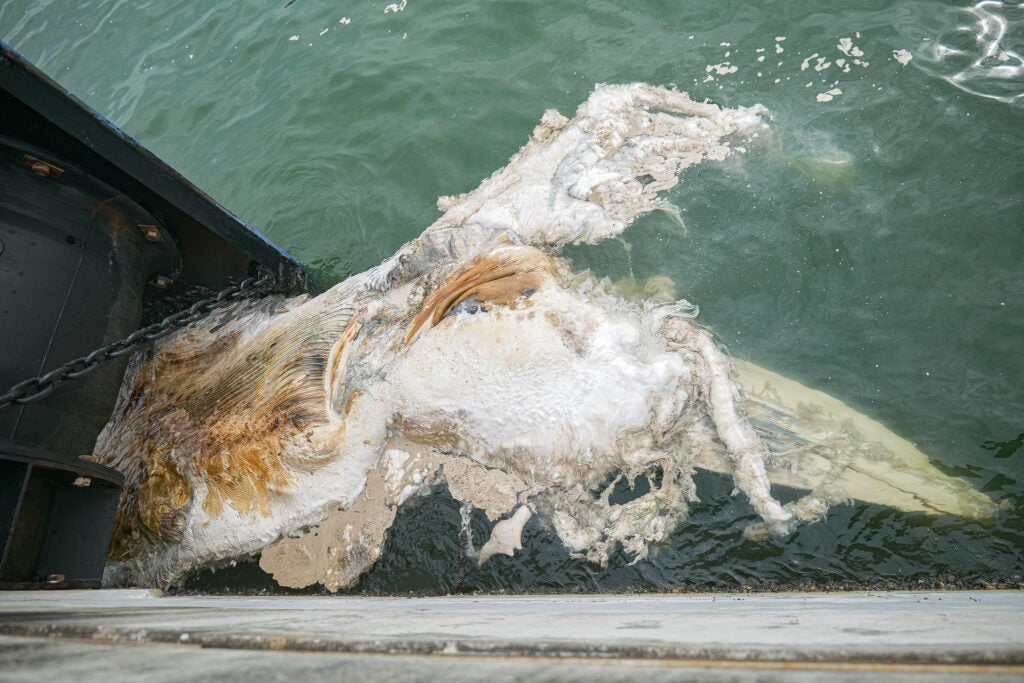
Floating whale carcass found in the waters beside Marina Bay Cruise Centre on 12 September 2025. (Photo credit: Lee Kong Chian Natural History Museum, National University of Singapore)
Missing the rear half of its body, the incomplete whale specimen measures approximately 6.3 metres in length and is estimated to weigh about six tonnes. Identified to be a rorqual whale from the genus Balaenoptera, LKCNHM’s team of scientists gauged that the whale would have been 9 to 12 metres long when alive.
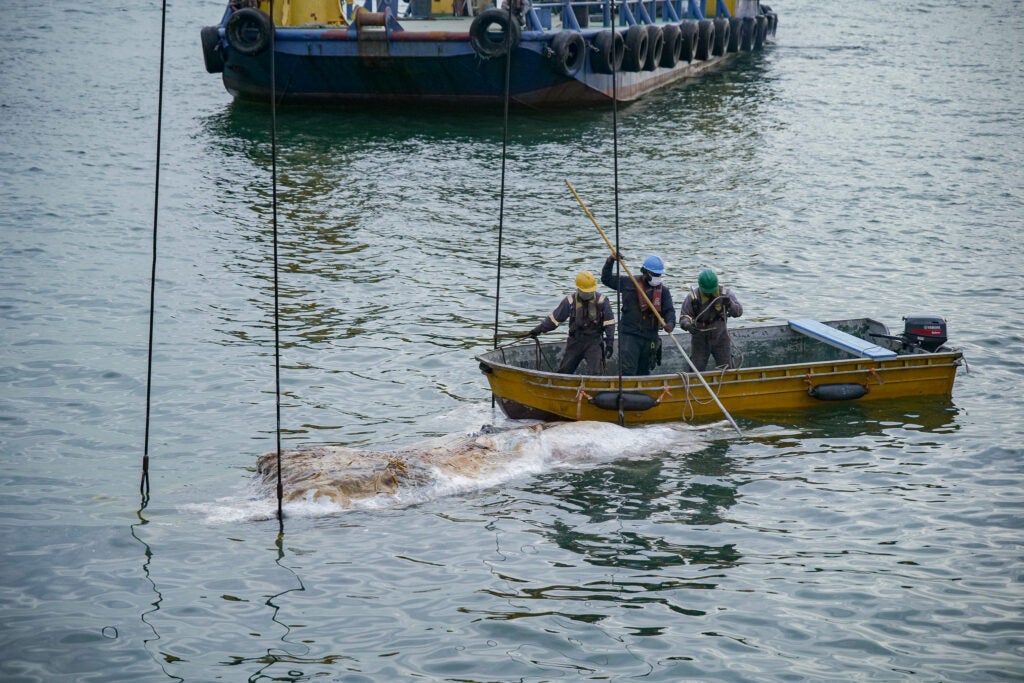
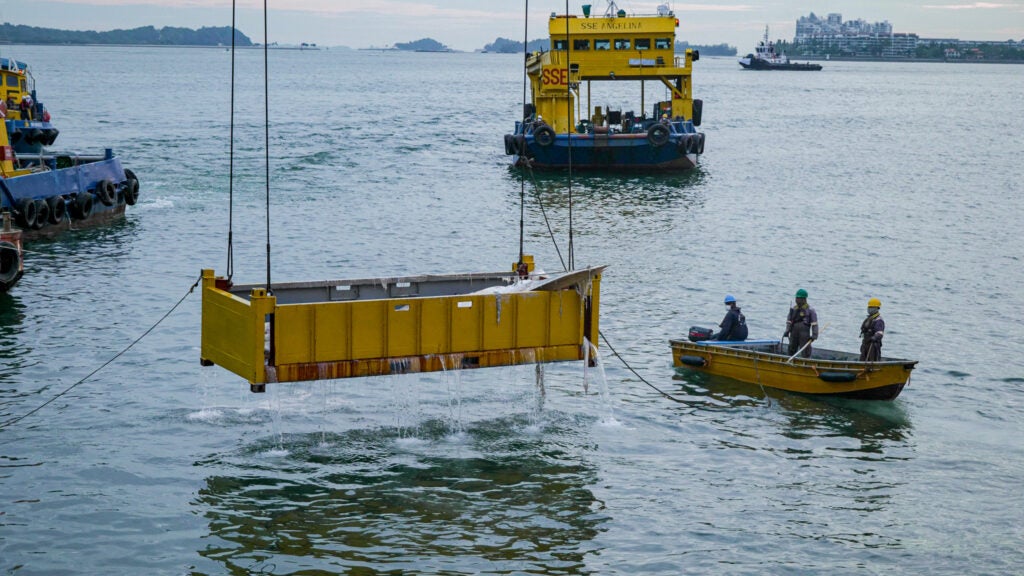
Whale carcass being retrieved by the Singapore Salvage Engineers (SSE) crew off the waters near Marina Bay Cruise Centre on 12 September 2025. (Photo credit: Lee Kong Chian Natural History Museum, National University of Singapore)
Baleen whales are large marine mammals distinguished by the presence of baleen plates instead of teeth. Made of keratin and comprising bristle-like hairs bound in connective tissue, these baleen plates are used to filter zooplankton and other small prey. Presently, there are 16 known species of baleen whales worldwide, ranging from the 6.5 metre long pygmy right whale to the 30 metre long blue whale.
Rare opportunity to study whale specimen
“Whale encounters in Singapore waters are rare. Hence, each stranding provides unique opportunities to study these large marine mammals,” said Dr Chua.
It has been a decade since LKCNHM has had the extraordinary opportunity to encounter and study a whale carcass found in Singapore waters. Affectionately named Jubi Lee, the sperm whale specimen that was washed up near Jurong Island in 2015, has since become one of LKCNHM’s most iconic gallery exhibits.
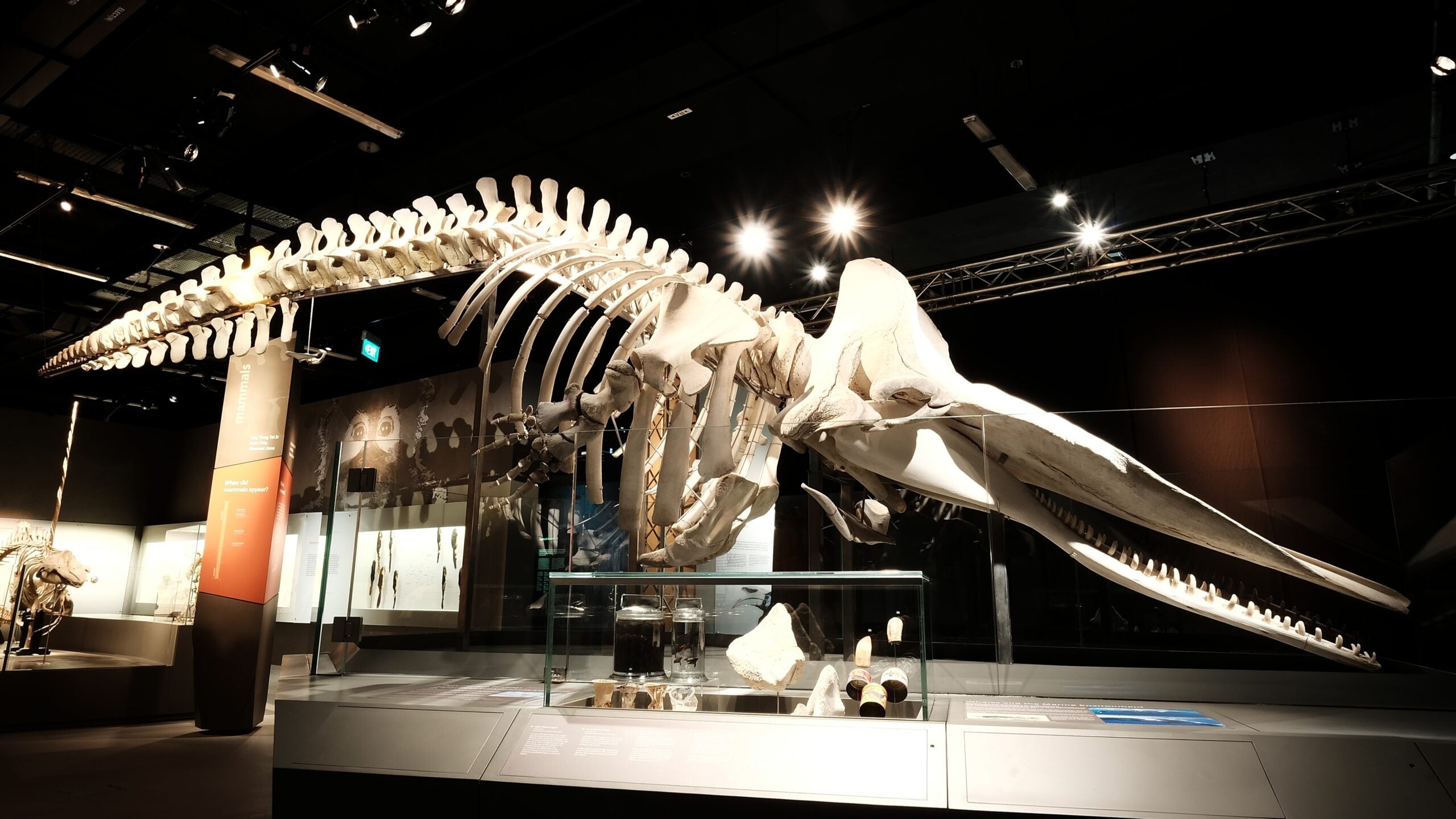
LKCNHM’s iconic sperm whale specimen, Jubi Lee, on display in the Museum’s gallery.
Associate Professor Darren Yeo, Head of LKCNHM, shared, “It is both moving and serendipitous that another whale carcass should arrive in our waters during our 10th anniversary year—exactly 10 years after the Museum’s launch and the discovery of Jubi Lee —just as we have been reflecting on a decade of research, public engagement, and conservation.”
More than a century ago, in 1907, the skeleton of a 13.4 metre blue whale that was found near Melaka in 1892 was put on display at the Raffles Museum at Stamford Road (now the National Museum of Singapore). The specimen was a major attraction until it was formally gifted to the National Museum of Malaysia (Muzium Negara) in 1974.
LKCNHM is currently conducting further studies on the whale carcass and has harvested tissue samples for genetic analysis. The age and sex of the whale is still undetermined. More details on the dissection process and subsequent findings will be shared in due course.
Source: NUS News