

Two mathematical worlds, one hidden connection
April 20, 2026Mathematicians at the National University of Singapore (NUS) and their collaborators have established a precise form of a conjectural duality, known as Relative Langlands duality, for an important class of mathematical spaces.
The work was led by Associate Professor Lei ZHANG from the Department of Mathematics, NUS together with collaborators Professor Zhengyu MAO and Assistant Professor Chen WAN from Rutgers University, provides strong new evidence for a far-reaching conjecture known as Relative Langlands duality. The research was published in the journal Inventiones Mathematicae.
Understanding symmetry in mathematics
A central challenge in mathematics is to understand symmetry: when two very different systems turn out to share the same underlying structure. Discovering such connections is fundamental because it may transform difficult problems into more accessible ones by viewing them from a different perspective.
In the Langlands program, mathematicians study deep links between numbers, symmetries, and functions known as automorphic forms. A refined version, called the relative Langlands program, focuses on what remains of these symmetries after imposing additional constraints, so-called period integrals. These period integrals often encode subtle arithmetic information and are closely related to special values of L-functions, another key arithmetic invariant in number theory. A typical guiding principle takes the form
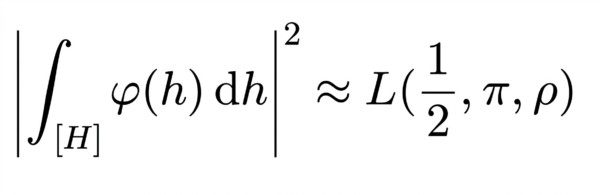
linking geometric data (the period integral) with arithmetic invariants (the special values of L-functions).
Inspired by ideas from quantum field theory, particularly electric–magnetic duality, BEN-ZVI, SAKELLARIDIS and VENKATESH proposed a striking new perspective: Relative Langlands duality. It predicts that a problem involving symmetries on one side has a corresponding “dual” problem on another side, where the same phenomenon appears in a different but equivalent form.
A new result for strongly tempered spherical varieties
A recent result establishes this duality for a fundamental class of objects known as strongly tempered spherical varieties, together with their dual sides through hyperspherical Hamiltonian structure. These are abstract spaces that capture symmetry in a particularly rich way and had long been difficult to handle in a unified manner. The new work shows not only that the mirror exists for these spaces, but maps out precisely how the two sides correspond to each other, something that had not been done before.
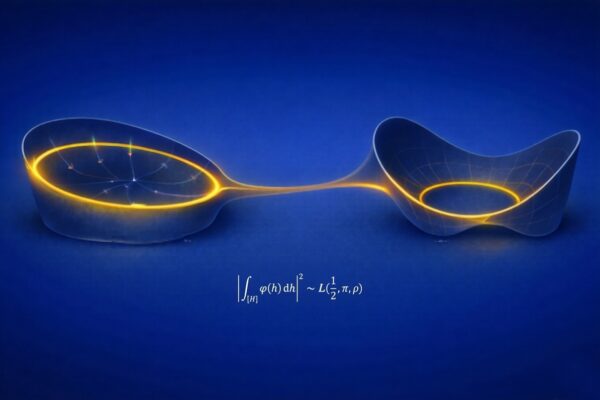
An artistic visualisation of Relative Langlands duality, illustrating how a boundary condition in one setting can be reinterpreted as a constraint in a dual setting. The formula shown, which relates a period integral (left) to a special value of an L-function (right), captures the precise mathematical relationship at the heart of this work. [Image generated using AI tool]
A unifying bridge across mathematics
The strength of the results is its unifying power. Mathematicians had studied many individual examples of these mirror relationships, each treated as its own separate problem in different corners of mathematics. This new work shows that all of them are in fact special cases of the same big picture.
Associate Professor Zhang said, “One of the appealing aspects of this work is that it reveals a coherent structure underlying problems that had previously been studied separately. By placing them within the framework of Relative Langlands duality, we can see how these problems are related and approach them from a more unified perspective.”
Looking ahead
Further work will extend these ideas to broader classes of spaces and sharpen the expected correspondences. The longer-term aim is to clarify how symmetry, geometry and arithmetic interact at a structural level, and to make these correspondences usable in concrete problems across representation theory and number theory.
While this work is in pure mathematics, it contributes to a broader effort to understand deep structures that connect different areas of mathematics. By uncovering hidden structure in mathematics, today’s abstract discoveries can become tomorrow’s practical tools.
Reference
Mao Z*; Wan C*; Zhang L*, “Relative Langlands duality for some strongly tempered spherical varieties” Inventiones Mathematicae DOI: 10.1007/s00222-025-01388-z Published: 2025.