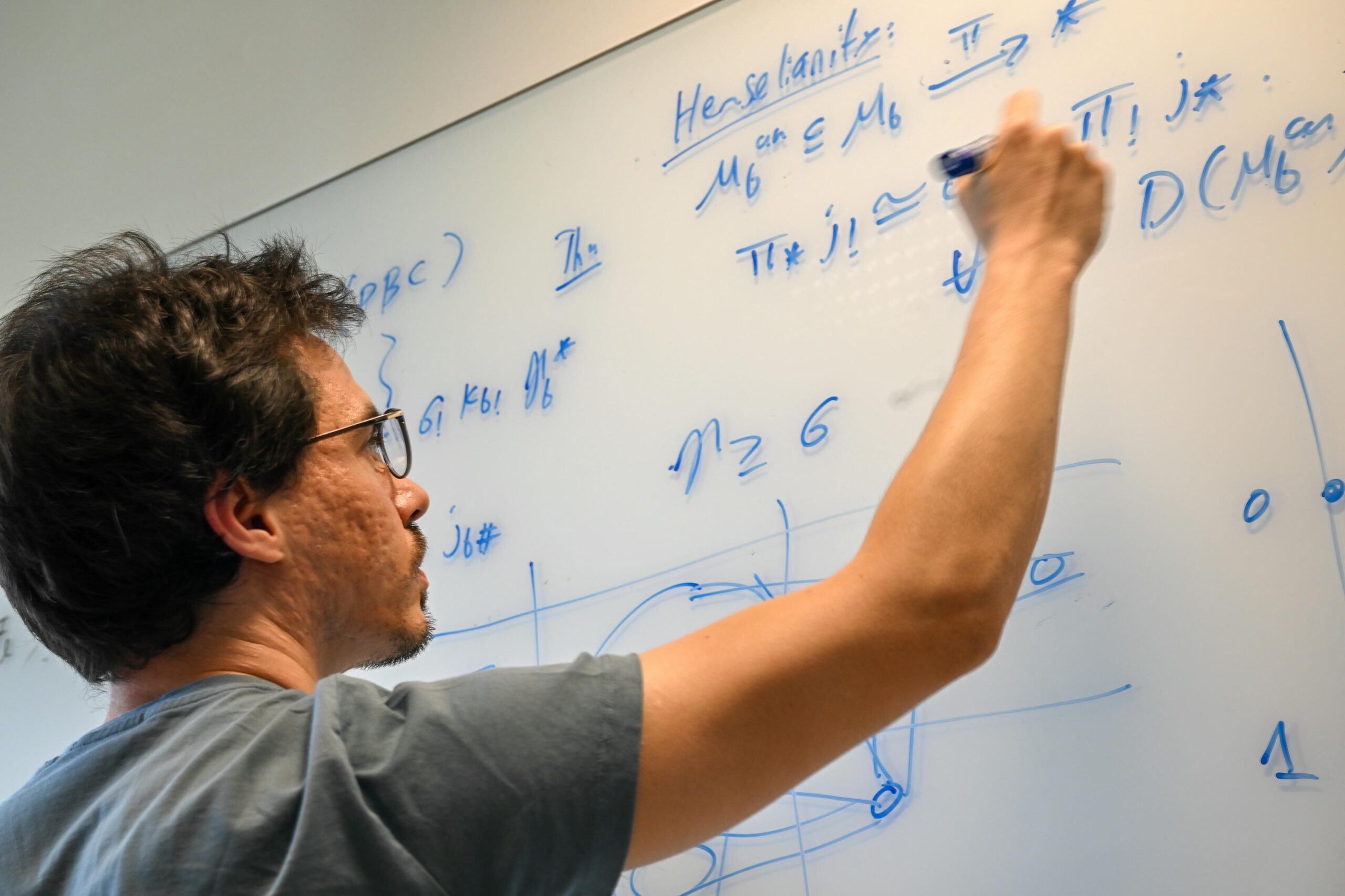
Chasing hidden patterns: Uncovering the secrets of numbers
March 24, 2026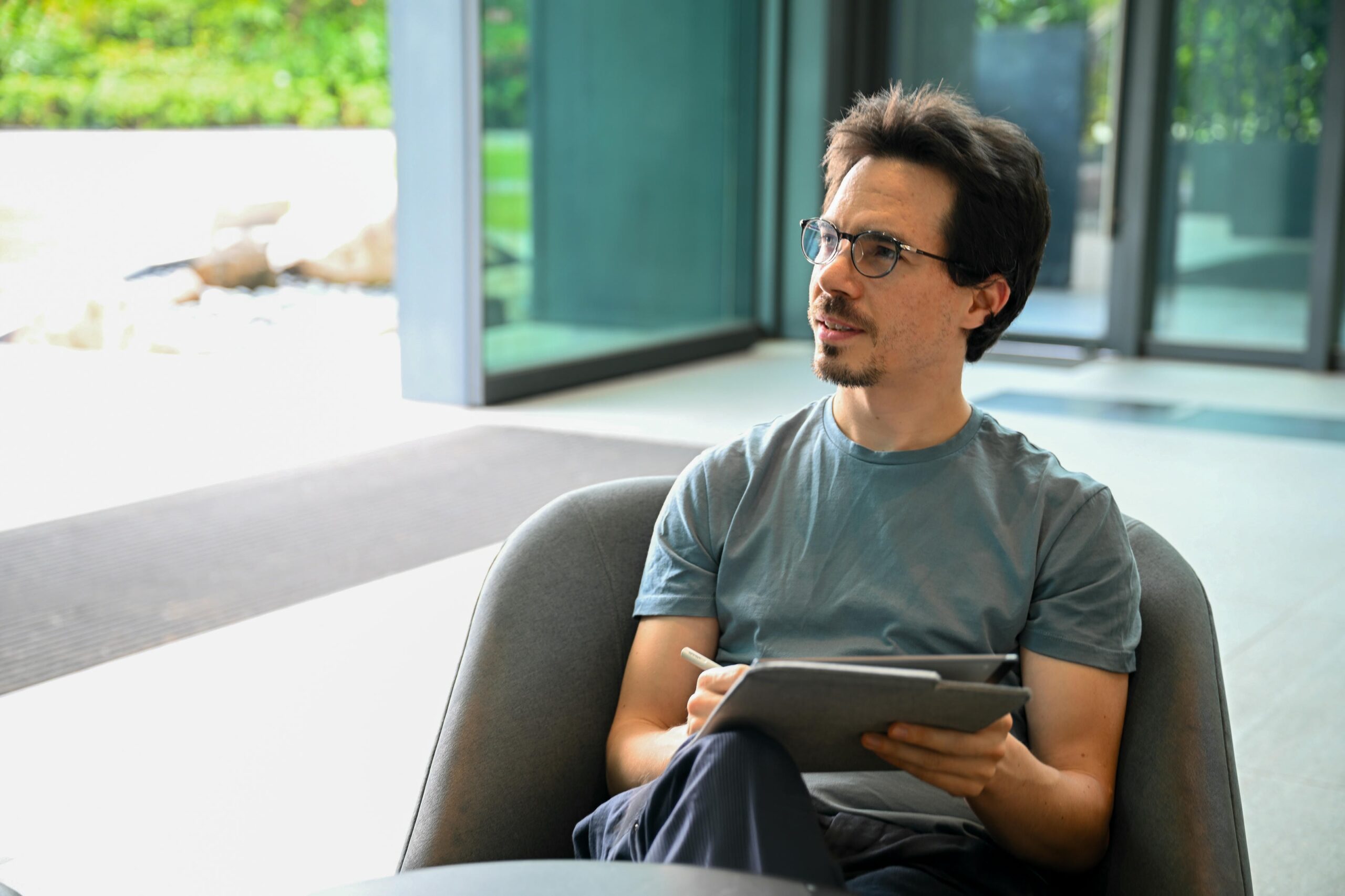
For as long as Asst Prof Ian Gleason can remember, mathematics felt less like a subject and more like a puzzle waiting to be explored. Long before research papers and academic conferences entered his life, curiosity about patterns had already taken root.
Growing up in Mexico, he and his siblings received an unusual daily challenge from their mother: a mathematics calendar compiled by the Mexican Mathematical Olympiad. Each day brought a new problem. Some were too difficult, but that did not matter. What mattered was the thrill when the answer finally clicked.
Those daily puzzles quietly shaped the way he thought about the world. Everything changed in his second year of high school when he discovered the Mathematics Olympiads and decided to give them a try. After passing the early rounds, he was invited to attend special training sessions for selected students.
This experience opened an entirely new perspective of mathematics for him – a landscape full of creativity, surprising ideas and multiple ways of thinking about the same problem. “For the first time, I didn’t get bored in math class anymore,” he says. “I discovered mathematics is much more profound than a set of tools for science or engineering.”
This insight eventually set him on the path that would lead to a career in research.
When studying becomes discovery
In college, he spent hours on problems outside his coursework, driven solely by curiosity, sometimes even inventing his own questions. “Most of the time those attempts led nowhere,” he says. “But occasionally I learned something important from trying.”
The defining project of his career began in his third year and grew into his PhD thesis. His advisor asked him to read a research paper and find a question that sparked his interest. A month later, he had a strategy – but one missing piece kept the whole argument from working.
That “small detail” took three years to resolve. “It felt like writing a novel,” he says. “I knew how the story started and how it ended, but I still had to write everything in between.” That long pursuit became the heart of his doctoral research.
The power and mystery of mathematics
Two motivations keep him drawn to mathematics.
The first is its transformative power. A change in perspective can make a difficult problem suddenly seem simple. “This gives me a sense of awe,” he says. “I feel like I can reach much further.”
The other is the mystery. “The most beautiful mathematics reveals a hidden truth,” he explains.
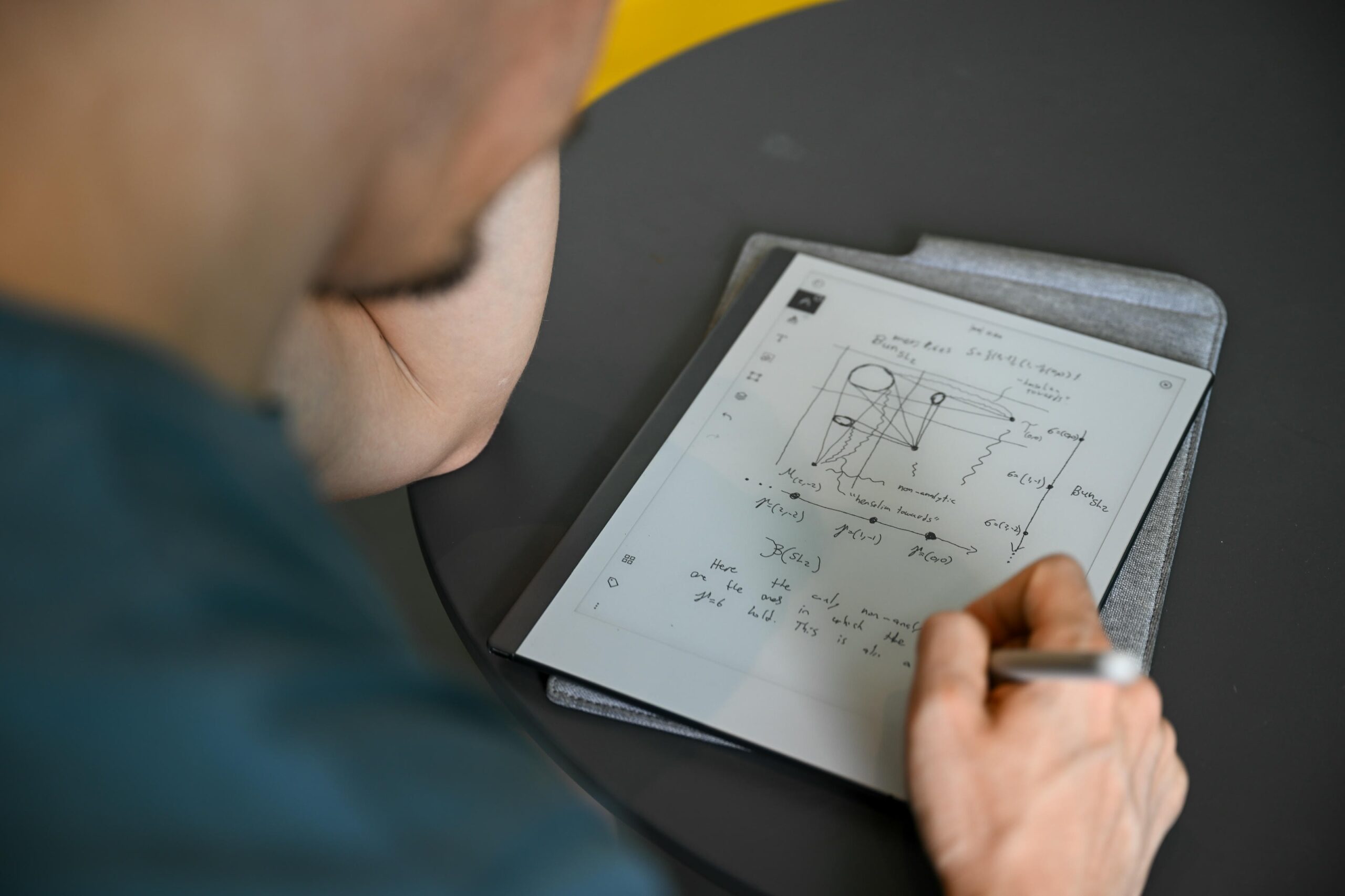
His field, arithmetic geometry, is full of intriguing puzzles that explore the hidden patterns within numbers. For more than a century, going back to the work of Dedekind and Weber, mathematicians have noticed surprising parallels between numbers and geometric shapes, leading to an unusual question: what if numbers aren’t static, fixed values? Instead, imagine them as active functions interacting with a deeper, structured “arithmetic space”. Over time, new generations of mathematicians have built on this idea – and raised even bigger questions.
If such a space exists, what does it look like? What are its properties? Could it reveal why numbers behave as they do?
“These questions are mind-blowing,” he says. “They keep me coming back.”
A new mathematical framework
Asst Prof Gleason’s research centres on the local Langlands program, often described as a “grand unifying theory of mathematics” that links two seemingly unrelated fields: number theory and harmonic analysis.
During his PhD, he developed a theory of “kimberlites” to study integral models. Building on mathematician Peter Scholze’s 2014 theory of “diamonds,” this framework introduced new geometric tools for investigating structures linked to the Langlands program.
Over the past four years, he has been working towards unifying these two distinct formulations of the categorical local Langlands correspondence. By bridging approaches from different mathematical traditions, his work weaves together diverse insights and opens fresh paths toward solving long-standing questions.
He finds great satisfaction seeing others use his methods to explore deeper geometric structures connected to the Langlands program. “It’s very rewarding,” he says, “when your work has a tangible impact in the field.”
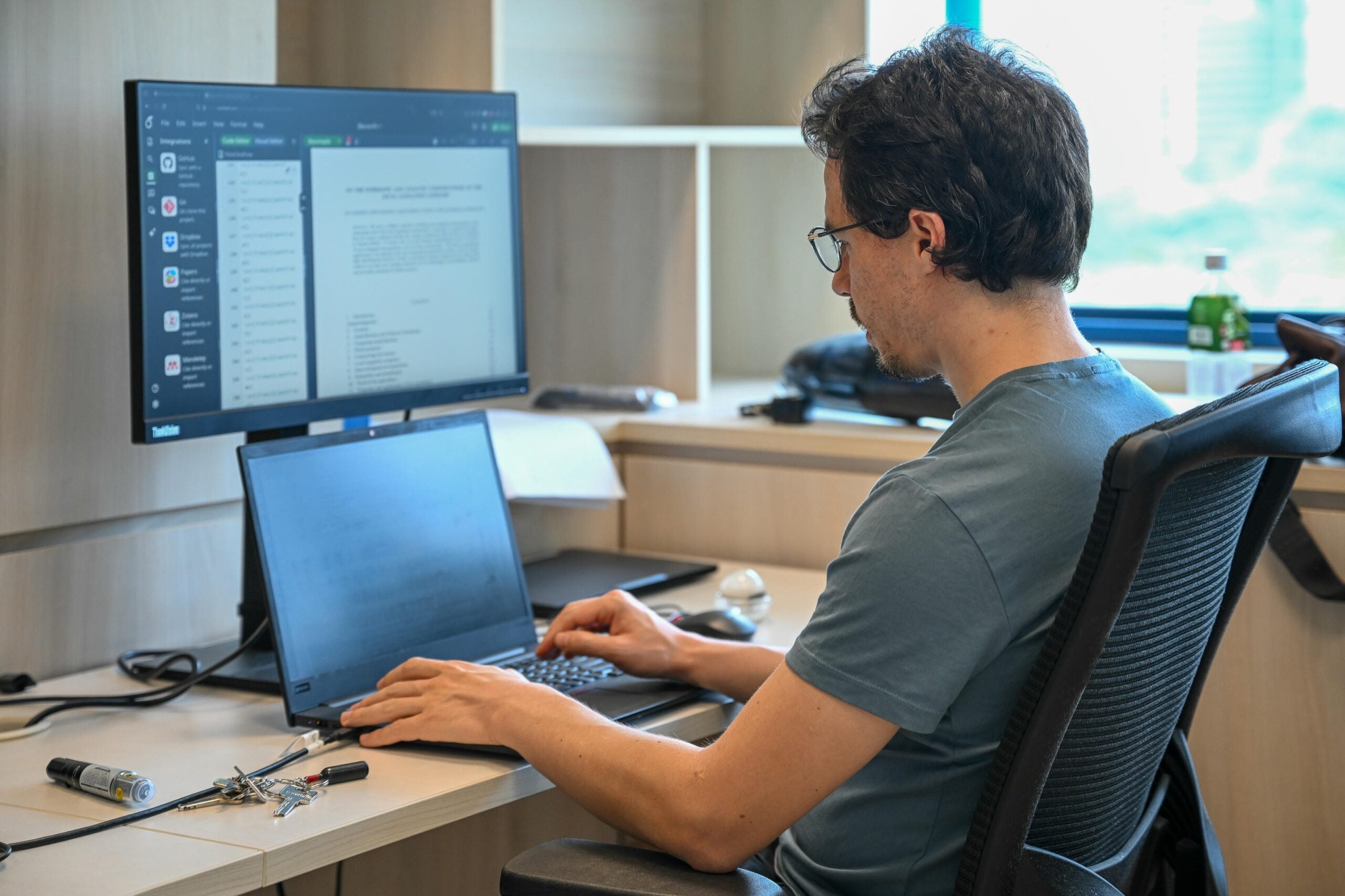
A near disaster during the pandemic
However, he is quick to point out that research has its highs and lows.
A year before completing his PhD, amid the pandemic, he received devastating news: a key reference he had relied on for his thesis contained an error that invalidated his work.
“I panicked,” he admits. But soon he plunged back in, running computations again and again until a pattern emerged. Step by step, he rebuilt his argument on firmer ground. “I’ve never worked as hard as I did during that time,” he says.
For now, his attention is turning to geometric structures known as Shimura varieties – advanced mathematical objects at the crossroads of geometry and number theory. More broadly, he hopes to see the categorical Langlands program maturing into a powerful framework that could even offer a new proof of its classical version.
Why this matters
To many, prime numbers and abstract symmetries seem distant from everyday life. But mathematics often proves its worth decades, or even centuries, later. “Mathematics comes long before its applications,” Asst Prof Gleason says.
Concepts once considered purely theoretical now underpin cryptography, computing and modern technology. “Today’s abstract discoveries could shape tomorrow’s technologies in ways we cannot yet imagine,” he adds.
To him, the appeal remains the same as it was when he was a child puzzling over that daily mathematics calendar. Somewhere behind the patterns of numbers, a deeper story is waiting to be uncovered.