

Growing covalent organic frameworks through coupling reactions
November 25, 2025Chemists at the National University of Singapore (NUS) have developed a methodology to enable coupling reactions for the growth of crystalline porous covalent organic frameworks, unlocking a new class of semiconducting magnets.
Covalent organic frameworks (COFs), which are crystalline porous polymers, have traditionally been formed through reversible polycondensation reactions. Although irreversible coupling reactions offer broader versatility and functional group compatibility, they have typically produced amorphous materials rather than crystalline COFs. A significant goal in the field has been to find ways to produce crystalline COFs using these more versatile coupling reactions. This challenge has now been addressed with the development of a micro-interfacial polymerisation method that utilises the Glaser–Eglinton coupling reaction to synthesize sp-carbon-conjugated COFs.
A research team, led by Professor Donglin JIANG from the Department of Chemistry at NUS, discovered that a two-phase system can create numerous micro-interfaces that spatially confine monomers and intermediate compounds. At these boundaries, the building blocks are held in place and react more slowly and orderly. Such a controlled environment aids the polymerisation process, allowing for the formation of well-defined structures even without a self-correction mechanism. This led to the development of a micro-interfacial polymerisation technique, which uses immiscible combinations of water and organic solvents. This method facilitates the well-known Glaser–Eglinton coupling reactions, yielding two-dimensional COFs with carbon linkages that form repeating patterns with hexagonal, tetragonal, and kagome topologies (as illustrated in the Figure).
The findings were published in the scientific journal Nature Synthesis.
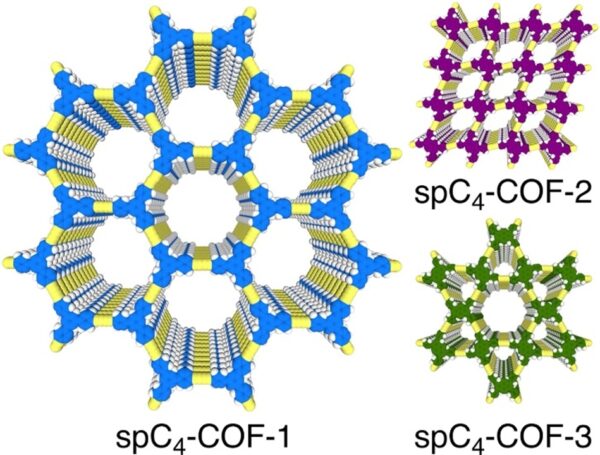
Representative crystal models of spC4-COFs: hexagonal spC4-COF-1 (left), tetragonal spC4-COF-2 (top right), and kagome spC4-COF-3 (bottom right), highlighting their ordered two-dimensional pore architectures formed via micro-interfacial coupling polymerisation. [Credit: Nature Synthesis]
This advancement enables the creation of novel semiconducting frameworks that also behave like magnets. When the materials are treated with iodine, the iodine pulls away some electrons, forming mobile “positive charges” (called holes) that can move through the material’s network. This boosts their electrical conductivity by eight orders of magnitude. At the same time, removing those electrons leaves behind tiny magnetic moments (unpaired “spins”) at specific points in the framework. As the internal lattice is rigid, it can hold these spins in place and make neighbouring spins interact in defined patterns, so the material can act like a paramagnet, an antiferromagnet or a ferromagnet.
The micro-interfacial polymerisation method offers a new pathway for synthesizing covalent organic frameworks (COFs) with diverse topologies through various coupling reactions. Given that coupling reactions encompass a broad spectrum of organic transformations, the research team intends to broaden the application of this micro-interfacial polymerisation strategy to include other types of coupling reactions, such as those involving C–C and CºC bond formation. This expanded approach could lead to the creation of previously unknown structures possessing novel properties and functionalities.
Professor Jiang said, “This work opens an avenue to the other half of the field. Our strategy conclusively demonstrates the feasibility of utilising coupling reactions for the design and construction of COFs.”
The team is enthusiastic about exploring how this method can facilitate the synthesis of new functional materials and systems that have, until now, remained inaccessible.
Reference
Li Z; Tao S; Addicoat M; Nakamura T; Jiang D* “Synthesis of covalent organic frameworks via coupling polymerization” Nature Synthesis DOI: 10.1038/s44160-025-00895-4 Published: 2025.