Congratulations to our Outstanding Undergraduate Researcher Prize (OURP) winners in Academic Year 2024/2025! Their work highlights meaningful undergraduate contributions to research that advance scientific understanding in areas ranging from fundamental science to sustainability and public health.
Ashvinath, Class of 2025 graduate, Major in Life Sciences
Recycling is not the only solution to plastic waste. Ashvinath is addressing the global issue of plastic pollution by engineering Escherichia coli (E. coli) bacteria to consume ethylene glycol – one of the building blocks of polyester plastic – and convert it into a valuable feedstock. His research is a showcase of how engineered organisms can help solve real-world environmental issues.
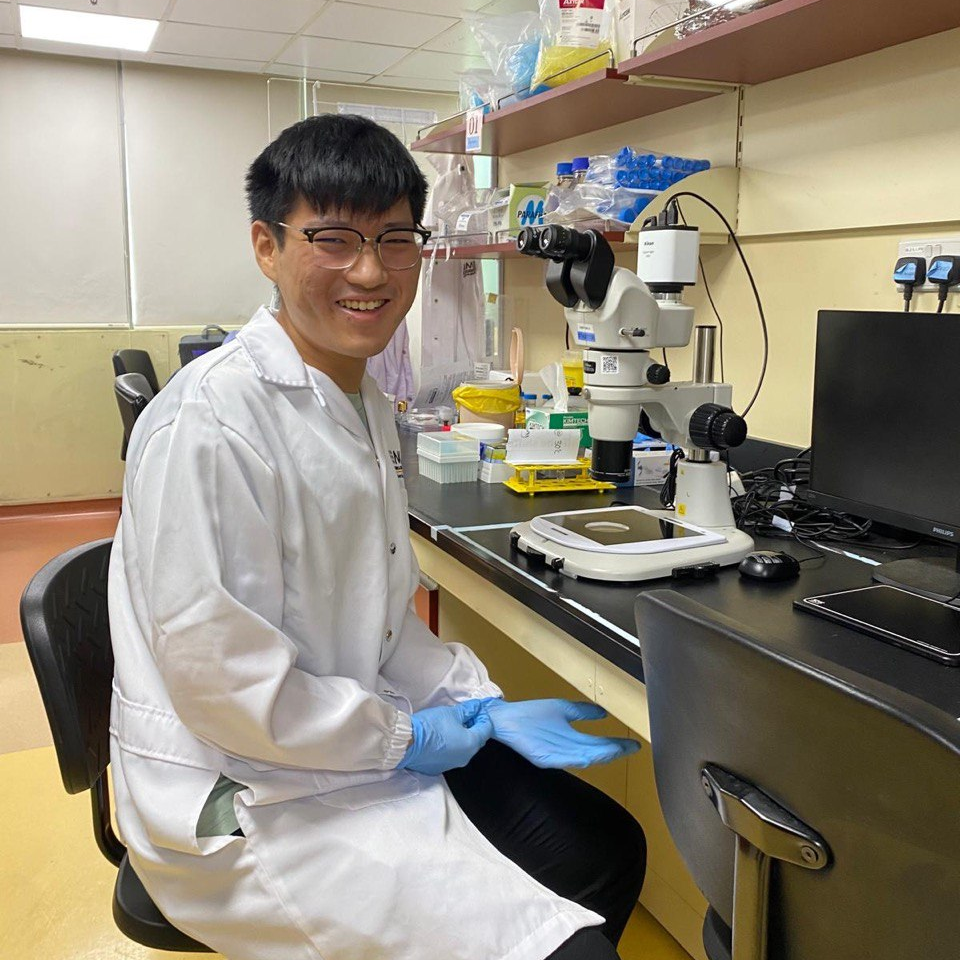
Wee Juin Shin, Year 3, Major in Life Sciences, Minor in Japanese Language Studies
Wee Juin Shin explores how cells move during processes like wound healing, immune responses and cancer spread. By using Eribulin, a cancer drug, he discovered a method to study cell movements without damaging their structure. This finding offers a novel approach to understanding cell behaviour and responses to the environment, with implications for cancer metastasis.
Pon Juan-Yi, Class of 2025 graduate, Major in Physics, Minor in Mathematics
Pon Juan-Yi investigates non-Hermitian condensed matter systems, where he developed a new computationally efficient method to identify topological features that explain stability in complex physical phenomena. His work advances our understanding of topological physics, which opens the door to potential applications in fields like quantum computation.
Ryan Lee Ray Yen, Class of 2025 graduate, Double Majors in Pharmaceutical Science and Life Sciences
Ryan Lee Ray Yen studies how our cells’ built-in sensors detect and defend against immunostimulatory ribonucleic acids (RNAs). He discovered non-canonical mechanisms of adenosine deaminase acting on RNA (ADAR1), a protein in cells, in regulating RNA. His findings highlight the mechanisms of intrinsic immune protection, which could open new pathways for treating diseases.
Kong Zuxiang, Class of 2025 graduate, Major in Mathematics, Minor in Statistics
Kong Zuxiang explores how convex sets, common in everyday geometry, grow minimally under doubling. By studying these sets in nonabelian groups, he developed a sharp new criterion for understanding their properties. These results offer a refined understanding of how additive structure interacts with quotient maps and suggest new directions for bridging geometry, analysis and combinatorics in nonabelian settings.
“We have barely scratched the surface of Timor-Leste’s biodiversity. New discoveries can have profound impacts on conservation and policy-making.”
In August 2022, we led an expedition to Timor-Leste in collaboration with Conservation International and the government of Timor-Leste. The Museum’s herpetologist, Dr CHAN Kin Onn, discovered a new species of bent-toed gecko which was named Cyrtodactylus santana, in reference to the Nino Konis Santana National Park, in which the gecko was discovered.